
Tutorial Categories
Last Updated: June 7, 2026 at 11:30
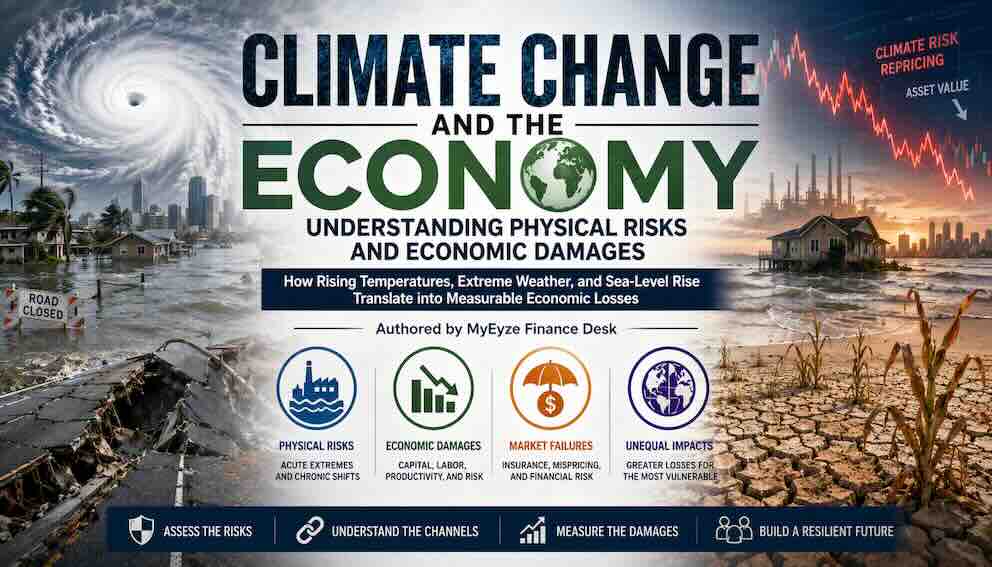
Climate Change and the Economy: Understanding Physical Risks and Economic Damages
A Macroeconomic Tutorial on How Rising Temperatures, Extreme Weather, and Sea-Level Rise Translate into Measurable Economic Losses
This tutorial explains how climate change creates physical risks—acute events like hurricanes and floods and chronic shifts like rising temperatures—and how these risks translate into economic damages. You will learn why the distinction between level effects and growth effects is crucial, how a localized flood in Thailand disrupted global hard drive production, and why sudden repricing of climate-exposed assets can trigger financial accelerator dynamics. The tutorial also covers insurance market failure, the feedback loop between adaptation and mitigation, and why climate damages are distributed unequally across rich and poor countries. This tutorial opens a new thematic unit on climate change and the economy. The Solow model's treatment of capital depreciation applies directly—climate change accelerates depreciation. The financial accelerator's collateral channel, developed in earlier tutorial, helps explain how climate shocks become amplified through credit markets. The credit cycles framework for stranded asset repricing will appear in the energy transition tutorial later in this series. Upcoming tutorials will cover environmental accounting, energy transition, and sustainable growth.
Introduction: A Roadmap Through Four Macroeconomic Channels
For a long time, climate change was discussed primarily as an environmental issue. That framing is scientifically accurate but misses a crucial dimension. Climate change is also a profound economic phenomenon. When a hurricane destroys a factory, that is destruction of capital. When a drought reduces crop yields, that is a supply shock that raises food prices. When extreme heat reduces outdoor work, that is a reduction in labor productivity that feeds directly into gross domestic product.
This tutorial focuses on physical risks—the direct harms a changing climate inflicts on people, property, and productive capacity—and how those risks translate into economic damages. To orient you from the beginning, climate change affects the macroeconomy through four channels that we will explore in depth:
- Capital depreciation increases through direct destruction, accelerated wear, and asset stranding.
- Labor productivity decreases, particularly for outdoor work in hot sectors.
- Total factor productivity decreases through supply chain disruptions and agricultural losses.
- Risk and uncertainty increase across insurance, credit, and investment decisions.
These four channels imply a lower steady-state output than traditional models predict. And through growth effects—which we will discuss in detail—the losses compound over time rather than being one-time hits. As we will see, tipping points would accelerate all four channels simultaneously, transforming gradual pressures into abrupt collapses.
Defining Physical Risks: Acute Versus Chronic Hazards
Economists and climate scientists divide physical risks into two broad categories. Acute physical risks are event-driven hazards that occur suddenly: hurricanes, floods, wildfires, heatwaves, and droughts. Chronic physical risks are longer-term shifts that unfold gradually: rising average temperatures, sea-level rise, changing precipitation patterns, and increased weather variability.
To make this concrete, imagine a Category 4 hurricane making landfall near Miami. Within a single day, thousands of homes are destroyed, the power grid is knocked offline, a major port closes, and highways become impassable. The economic damages are immediate and large. Now contrast this with sea-level rise around the same city. Over thirty years, the average high tide creeps higher by one foot. Nuisance flooding that happened once per decade now happens ten times per year. Roads deteriorate faster from saltwater exposure. Property values in low-lying neighborhoods decline. The damage is real but spread over time rather than concentrated into a single event.
These two categories affect the three fundamental factors of production: capital, labor, and land.
How Physical Risks Affect Capital, Labor, and Land
Capital—the stock of buildings, machines, and infrastructure—is destroyed directly by floods, fires, and storms. It is also destroyed indirectly when chronic heat and humidity accelerate depreciation. A road that might have lasted thirty years in a stable climate may need resurfacing after twenty years when freeze-thaw cycles become more extreme. An air conditioning unit that ran six hundred hours per summer might run twelve hundred hours, wearing out twice as fast.
Labor is affected through health and productivity. Higher temperatures increase heatstroke and cardiovascular strain, especially for outdoor workers. Wildfire smoke degrades air quality, causing respiratory illnesses. Studies of agricultural workers in India have found that on days exceeding 35°C (95°F), labor output falls fifteen to twenty percent. Research on plantation workers in Central America shows productivity losses of twenty to thirty percent during heatwaves. Even office workers show slower reaction times and more errors above 25°C (77°F). A one-degree Celsius increase in annual average temperature in a hot country is associated with a two to three percent reduction in industrial and agricultural output.
Land—or natural capital—experiences shifts in crop suitability as temperature and precipitation patterns change. Wheat yields decline in historically productive regions while areas farther north become newly arable. Forests face pest infestations like the pine bark beetle outbreaks in western North America, where milder winters no longer kill beetle larvae. Coastal land is lost to sea-level rise and erosion. Critically, land that becomes unsuitable for its current use is a stranded asset in exactly the same sense as a coastal condominium whose flood risk has made it uninsurable. A farmer who purchased land expecting to grow wheat and now faces persistent drought has suffered a capital loss no different from a developer whose beachfront tower is now underwater at high tide. This connection between land degradation and asset stranding will recur throughout the tutorial.
Why Growth Effects Make Climate Damages Potentially an Order of Magnitude Larger
Older models of climate damages, including early versions of the Dynamic Integrated Climate-Economy (DICE) model, assumed that climate change produces level effects rather than growth effects. A level effect means a climate shock causes a one-time reduction in GDP, after which the economy resumes growing at its previous rate. A growth effect means the shock reduces the growth rate itself, and that slower growth compounds over time.
The difference in magnitude is staggering. Consider an economy starting with GDP of 100. Under a level effect, a ten percent shock reduces GDP to 90, but two percent annual growth thereafter yields 90 × (1.02)^30 ≈ 163 after thirty years. Under a growth effect, the same initial ten percent shock reduces the growth rate from two percent to 1.5 percent, yielding 90 × (1.015)^30 ≈ 141 after thirty years. The gap of 22 GDP units widens to 75 units after sixty years, and continues growing.
The empirical evidence for growth effects comes from multiple research teams. Melissa Dell, Benjamin Jones, and Benjamin Olken (2012) examined fifty years of data across 125 countries and found that a one-degree Celsius temperature increase in a poor country reduced economic growth by approximately 1.3 percentage points, with persistent effects. Solomon Hsiang and colleagues (2015) synthesized hundreds of estimates and concluded that climate change reduces growth rates, particularly in hot, poor countries. The 2021 study by Matthew Kahn and coauthors reinforced this at the subnational level. The implication is that traditional models assuming only level effects may underestimate climate damages by a factor of ten or more over long horizons.
Capital Misallocation and Stranded Assets: The Financial Accelerator Connection
Climate risk does not wait for physical destruction to cause economic damage. It misallocates investment before any destruction occurs. Investors make decisions today based on expectations about the future. When those expectations understate climate risk, capital gets deployed in places and forms that will later become economically unviable. Those investments become stranded assets.
Consider coastal real estate. A developer evaluating a condominium tower on a Florida barrier island might assume a fifty-year useful life. But if sea-level rise will cause chronic tidal flooding within twenty years, and if flood insurance premiums will rise dramatically or become unavailable, the true useful life is much shorter. The developer who ignores climate risk will build, and the tower will look successful for a decade or two. Then property values will collapse, insurance will become unaffordable, and the capital will be stranded—not destroyed by a storm, but wasted because it was deployed in a location that became economically non-viable. The evidence is already accumulating. Studies by Federal Reserve researchers found that homes exposed to sea-level rise sell at a discount, but the discount is much smaller than physical risk implies, meaning capital is still flowing into risky locations.
The financial stability risk here connects directly to the financial accelerator framework from Tutorial 54. When climate-exposed assets are suddenly repriced downward, the collateral that borrowers have pledged against loans loses value. Lenders respond by reducing borrowing limits, calling in margin requirements, or raising interest rates. Borrowers who cannot access new credit reduce investment and consumption. This credit contraction amplifies the initial repricing shock into a broader macroeconomic downturn. The International Monetary Fund has highlighted this cascade as a growing concern. The same logic applies to fossil fuel infrastructure, highways in thawing permafrost zones, and agricultural equipment designed for rainfall patterns that are no longer stable.
Insurance Markets as a Failing Buffer
Insurance is supposed to be the shock absorber between physical damages and macroeconomic impacts. Policyholders pay premiums over time, and the pooled funds compensate the unlucky few who experience losses. This works when events are infrequent enough that premiums can cover claims, when risks are independent enough that many policyholders do not all lose at once, and when insurers can price risk using historical data. Climate change is breaking all three conditions.
In California, several major insurers have stopped writing new homeowners policies, citing increasing wildfire frequency and intensity. In Florida, national insurers have scaled back hurricane exposure, leaving homeowners to rely on an undercapitalized state-backed insurer. In Louisiana, a series of hurricanes between 2020 and 2022 caused several smaller insurers to become insolvent.
The macroeconomic consequences are severe. When insurance is unavailable, households absorb disaster costs themselves, reducing consumption and pulling demand out of local economies. Mortgage markets rely on insurance—lenders require it as a condition of loans. When insurance withdraws, mortgages become unavailable, freezing housing markets in high-risk zones. And when underinsured households face disaster, pressure falls on governments to provide disaster relief, socializing losses that private markets were unwilling to bear. Each of these channels transforms a localized climate event into a broader macroeconomic disturbance.
Supply Chain Disruption: The 2011 Thailand Floods and Global Hard Drives
The total factor productivity channel mentioned in our introduction requires a concrete illustration, and the 2011 Thailand floods provide the canonical example. Heavy monsoon rains—exactly the kind of extreme precipitation event that becomes more likely and more severe in a warming world—caused flooding that submerged large parts of Thailand, including several industrial estates north of Bangkok that were hubs for electronics and automotive parts manufacturing.
The direct damage to factories in Thailand was substantial, but the indirect damage was global in scope. Hard disk drives, which are essential components for computers and data centers, were manufactured predominantly in Thailand at that time. When the floods shut down those factories, global hard drive production stalled for months. Prices for hard drives nearly doubled in the weeks following the floods. Computer manufacturers in China delayed shipments, assembly plants in Mexico reduced output, and data center operators in the United States faced higher costs and supply uncertainty. A flood in one country—caused by weather patterns that climate change is intensifying—disrupted a global supply chain for a product that had no obvious connection to flooding. This is the essence of supply chain transmission: climate shocks propagate through production networks in ways that are difficult to predict and impossible to fully hedge against.
Adaptation: Costs, Limits, and the Feedback Loop with Mitigation
Adaptation reduces climate damages, but it is not free, and it is not available equally to all. Wealthier countries and wealthier individuals can afford adaptation investments—air conditioning, sea walls, drought-resistant crops—while poorer ones cannot. The Netherlands has spent billions on coastal defenses. Bangladesh cannot afford comparable protection.
But a crucial distinction is missing from many discussions of adaptation. Some adaptation measures reduce damages without imposing offsetting costs. Others reduce damages but create new costs or even worsen the underlying problem. Air conditioning is the canonical example. It reduces heat mortality and productivity losses, saving lives and preserving economic output. But air conditioning consumes energy. If that energy comes from fossil fuels, it increases emissions, which accelerates warming, which creates more need for air conditioning. This is a feedback loop between adaptation and mitigation—adaptation that increases emissions can undermine the very mitigation efforts intended to stabilize the climate.
This has profound implications for policy. Not all adaptation is created equal. Planting trees for shade reduces heat exposure while sequestering carbon—adaptation and mitigation align. Building seawalls protects coastal infrastructure but does not affect emissions—neutral. Expanding air conditioning in hot, fossil-fuel-dependent grids reduces one form of damage while amplifying another. Recognizing this trade-off is essential for evaluating adaptation investments.
General Equilibrium: Price Transmission Across Borders
Most examples thus far have taken a partial equilibrium approach—looking at the direct effect of a climate shock on a specific sector or region, holding everything else constant. Macroeconomics requires general equilibrium analysis that accounts for price adjustments, substitution effects, and reallocation across sectors.
The most powerful general equilibrium effect is cross-border price transmission. When a drought reduces crop yields in one region, agricultural supply decreases and prices rise. Those higher prices harm consumers everywhere, especially poor urban consumers in entirely different countries who had no direct exposure to the original climate shock. A farmer in India whose wheat fails suffers direct crop loss. A street vendor in Lagos who must pay more for imported wheat flour because of a drought in Russia suffers no direct climate exposure but experiences real economic harm through the price channel.
The evidence is clear. The 2010 heatwave and drought in Russia reduced wheat yields by approximately thirty percent, leading Russia to ban grain exports. Global wheat prices nearly doubled. Countries from Egypt to Bangladesh, which import large fractions of their wheat, faced food price spikes that triggered social unrest and contributed to the Arab Spring uprisings. Climate change in one region became a macroeconomic problem—and a political stability problem—in another.
This cross-border price transmission connects directly to the global inequality argument we will develop further. Poor countries are more dependent on imported food, spend larger fractions of household income on food, and have weaker social safety nets to absorb price shocks. Climate damages in a rich, temperate agricultural region can impose larger proportional welfare losses on poor, hot, import-dependent countries than the direct damages those countries experience from their own climate hazards.
Tipping Points and Fat-Tail Risk: Accelerating All Four Channels
Much of this tutorial has assumed smooth, continuous relationships between temperature and damages. But climate science suggests tipping points—thresholds beyond which change becomes abrupt, self-reinforcing, and potentially irreversible. Examples include the collapse of the West Antarctic Ice Sheet, which would accelerate sea-level rise dramatically; the shutdown of the Atlantic Meridional Overturning Circulation, which would alter weather patterns across Europe and North America; methane release from thawing permafrost, which would accelerate warming in a feedback loop; and dieback of the Amazon rainforest, transforming a carbon sink into a carbon source.
From an economic perspective, tipping points matter because they would accelerate all four of our channels simultaneously. Capital depreciation would surge as sea levels rise faster and storms intensify. Labor productivity would collapse in regions experiencing abrupt climate shifts. Total factor productivity would be destroyed as agricultural systems and supply chains face discontinuous changes. And uncertainty would become extreme when known thresholds approach but exact trigger points remain unknown. Tipping points transform gradual pressures into abrupt collapses, breaking the smooth damage functions upon which standard models rely.
This leads to fat-tail risk. In a normal distribution, extremely large events are so unlikely that they contribute negligibly to the expected value. In a fat-tailed distribution, extremely large events have higher probabilities. The climate economist Martin Weitzman argued that uncertainty about climate sensitivity—how much warming results from a given increase in atmospheric carbon dioxide—has a fat tail. There is a non-negligible probability of extremely high warming producing catastrophic damages. When expected damages are dominated by small-probability catastrophic outcomes, even risk-neutral decision-makers should take precautionary action.
The Discount Rate: An Ethical Choice, Not a Technical One
The choice of discount rate is one of the most consequential decisions in climate economics. It is not primarily a technical disagreement about what market interest rate to use. It is fundamentally a disagreement about ethics—about how much weight to place on the welfare of future generations relative to the current generation.
William Nordhaus, who developed the DICE model, argues the discount rate should be based on observed market returns on capital—typically one to two percent for safe assets, five to seven percent for risky capital. Using a discount rate in this range means costs and benefits far in the future are heavily discounted. A damage of one hundred dollars one hundred years from now, discounted at five percent, has a present value of less than one dollar.
Nicholas Stern, in his 2006 review for the UK government, rejected this approach. He argued there is no ethical justification for discounting future welfare simply because it occurs later. He used a pure rate of time preference of 0.1 percent per year—essentially zero. The result was dramatically different: Stern concluded climate change could cost five to twenty percent of global GDP by 2200, and aggressive immediate emissions reductions passed a cost-benefit test by a wide margin.
The debate is not about arithmetic. It is about whether future people matter as much as present people. Economics cannot answer this question alone. The responsible approach is to be explicit about the ethical assumptions embedded in any climate damage calculation.
The Unequal Distribution of Climate Damages
Climate damages are not distributed evenly across countries or across people within countries. This matters not only for justice but because inequality feeds back into macroeconomic outcomes through migration, political instability, and development traps.
Across countries, poorer, hotter countries suffer larger GDP losses from temperature increases than richer, cooler countries. Burke, Hsiang, and Miguel estimated each degree Celsius of warming reduces GDP growth by approximately one percent in rich countries but more than two percent in poor countries. The countries that have contributed least to historical emissions—most of sub-Saharan Africa, South Asia, and small island developing states—suffer the largest proportional losses.
Within countries, poorer and more vulnerable populations suffer larger damages. Hurricane Katrina showed that low-income and minority households were disproportionately likely to live in flood-prone areas, less likely to have insurance, less likely to afford evacuation, and less likely to recover pre-storm income levels. The 2021 Pacific Northwest heatwave caused most heat-related deaths among elderly people living alone in poorly insulated housing.
The macroeconomic consequences are serious. Poorer households have less savings, less credit access, and less political influence. A climate shock can push a household below subsistence, creating a poverty trap from which recovery is impossible. Children may be taken out of school to work, perpetuating the cycle. The World Bank estimates climate change could force more than 200 million people to move within their own countries by 2050. Migration can be effective adaptation but also creates social tensions and political instability.
Synthesis: The Four Channels Revisited
Let us return to the four-channel framework. First, capital depreciation increases through direct destruction, accelerated wear, and asset stranding. Second, labor productivity decreases, particularly for outdoor work in hot sectors. Third, total factor productivity decreases through supply chain disruptions like the 2011 Thailand floods, agricultural losses, and cross-border price transmission. Fourth, risk and uncertainty increase across insurance, credit, and investment decisions—with sudden repricing of stranded assets capable of activating financial accelerator dynamics.
Taken together, these four channels imply lower steady-state output for any given temperature increase than traditional models predict. Through growth effects, the losses are not one-time hits but persistent drags that compound over decades. Tipping points would accelerate all four channels simultaneously, transforming gradual pressures into abrupt collapses. Countries that are already hot, already poor, and already lacking adaptive capacity suffer the largest proportional losses.
Conclusion
Physical climate risks are not external to the economy. They penetrate directly into capital, labor, productivity, and uncertainty. The distinction between level effects and growth effects is crucial: damages that reduce growth rates compound over time, potentially making climate change an order of magnitude more costly than older models suggested. Insurance markets are failing in high-risk regions. Supply chains propagate localized floods into global disruptions. Adaptation reduces damages but can create feedback loops with mitigation. General equilibrium effects transmit climate damages across borders through price channels. Tipping points would accelerate all four channels simultaneously. The discount rate debate is ultimately an ethical choice about valuing future generations. And climate damages are distributed deeply unequally. The next tutorials in this series will explore environmental accounting, energy transition, and sustainable growth—the policy frameworks for responding to the risks this tutorial has laid out. Understanding the physical risks is the necessary first step. Acting on that understanding is the task that follows.
About Swati Sharma
Lead Editor at MyEyze, Economist & Finance Research WriterSwati Sharma is an economist with a Bachelor’s degree in Economics (Honours), CIPD Level 5 certification, and an MBA, and over 18 years of experience across management consulting, investment, and technology organizations. She specializes in research-driven financial education, focusing on economics, markets, and investor behavior, with a passion for making complex financial concepts clear, accurate, and accessible to a broad audience.
Disclaimer
This article is for educational purposes only and should not be interpreted as financial advice. Readers should consult a qualified financial professional before making investment decisions. Assistance from AI-powered generative tools was taken to format and improve language flow. While we strive for accuracy, this content may contain errors or omissions and should be independently verified.