
Tutorial Categories
Last Updated: April 18, 2026 at 10:30
GDP, GNP, and National Income: Understanding the Difference Between What a Country Produces and What It Earns
A Step-by-Step Guide to Domestic vs National Income, Net Factor Income from Abroad, and the Relationships Between GDP, GNP, NNP, and Other Key Measures
This tutorial explores the important distinction between Gross Domestic Product (GDP) and Gross National Product (GNP)—two measures that are often confused but tell very different stories about an economy. You will learn why GDP counts production within a country's borders regardless of ownership, while GNP (now often called Gross National Income, GNI) counts production by a country's residents regardless of location. We will walk through the concept of net factor income from abroad—the adjustment that turns GDP into GNP—and explore the further adjustments that lead to Net National Product (NNP) and national income. Using real-world examples from countries with large foreign investments (like Ireland) and countries with many citizens working abroad (like Mexico and the Philippines), this tutorial shows how these different measures reveal different aspects of economic reality and why understanding the distinction matters for interpreting a country's true economic position.
Introduction: The Difference Between Where and Who
Imagine two farmers. One owns a large plot of land and works it herself, growing wheat that she sells at the market. Another farmer owns no land but travels to a neighboring country where he works on a large corporate farm, earning a wage that he sends back home to his family. Who is contributing to which economy? The first farmer's production counts in the GDP of her country because it happens within its borders. The second farmer's production counts in the GDP of the country where he works, but his earnings—the income he sends home—counts in the GNP of his home country.
This distinction between where production happens and who owns the factors of production is at the heart of understanding GDP, GNP, and national income. Gross Domestic Product (GDP) measures production within a country's borders, regardless of who owns the factories or land. Gross National Product (GNP) measures production by a country's residents, regardless of where that production takes place. (In modern statistical terminology, GNP is often called Gross National Income, or GNI, but the concept is the same.) In a world where capital flows freely across borders and millions of people work in countries other than their own, the difference between GDP and GNP can be substantial—and it tells us something important about a country's economic structure.
In this tutorial, we will explore the relationship between GDP and GNP, the concept of net factor income from abroad that connects them, and the further adjustments that lead to Net National Product (NNP) and national income. We will walk through examples from countries like Ireland (where foreign multinationals have made GDP much larger than GNP), Mexico and the Philippines (where remittances from citizens working abroad make GNP larger than GDP), and the United States (where the gap is relatively small but reveals interesting patterns). By the end, you will understand why these different measures exist, what they tell us, and why economists need to look at more than just GDP to understand a country's true economic position.
The Basic Distinction – GDP vs GNP
Let us start with clear definitions.
Gross Domestic Product (GDP) is the total market value of all final goods and services produced within a country's borders during a specific period, regardless of who owns the factors of production. If a Japanese-owned car factory operates in Tennessee, the cars it produces count as part of U.S. GDP because they are produced within the United States. If a Mexican worker picks fruit on a California farm, that fruit counts as part of U.S. GDP because it is produced within the United States.
Gross National Product (GNP) is the total market value of all final goods and services produced by a country's residents during a specific period, regardless of where that production takes place. (The modern term is Gross National Income, or GNI, but the concept is the same.) If an American-owned factory operates in Mexico, the goods it produces count as part of U.S. GNP because they are produced by U.S. residents. If an American engineer works in Saudi Arabia, her salary counts as part of U.S. GNP because she is a U.S. resident.
It is important to note that GNP is based on residency, not citizenship. A foreign citizen who has lived and worked in the United States for many years is considered a U.S. resident, and their income would be part of U.S. GNP. Conversely, a U.S. citizen who has permanently moved abroad and established residency elsewhere would have their income counted in that country's GNP, not the United States'. This residency basis is what makes GNP a measure of the income available to people living in a country, regardless of their citizenship.
The relationship between GDP and GNP is captured by a simple formula:
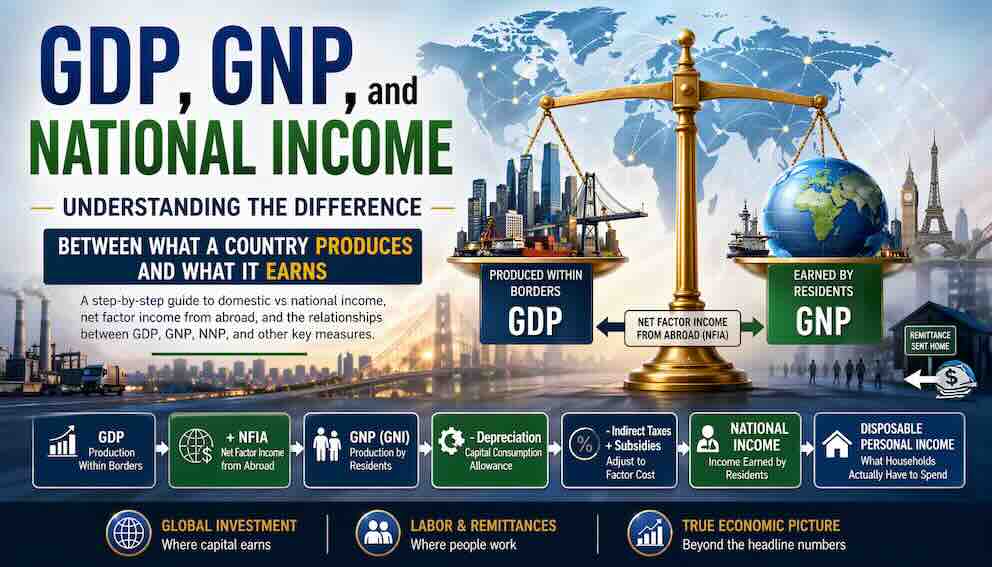
GNP = GDP + Net Factor Income from Abroad (NFIA)
Net factor income from abroad is the income earned by a country's residents from their overseas investments and work, minus the income earned by foreigners from their investments and work within the country. More formally:
NFIA = (Income earned by domestic residents in foreign countries) − (Income earned by foreign residents in the domestic country)
This includes three main components: compensation of employees (wages and salaries earned by residents working abroad, minus wages earned by foreign residents working within the country), investment income (dividends, interest, and profits earned by domestic residents from their foreign investments, minus similar income earned by foreign residents from their domestic investments), and reinvested earnings on foreign direct investment. Reinvested earnings are included even if they are not repatriated because they represent income that has been earned by domestic capital, even if the profits are not immediately sent home.
When NFIA is positive, GNP is larger than GDP. This means the country's residents are earning more from abroad than foreigners are earning from within the country. When NFIA is negative, GNP is smaller than GDP. This means foreigners are earning more from within the country than the country's residents are earning from abroad.
Key takeaway: GDP measures production within a country's borders; GNP (or GNI) measures production by a country's residents. The difference is net factor income from abroad (NFIA). When NFIA is positive, GNP exceeds GDP; when negative, GDP exceeds GNP. GNP is based on residency, not citizenship.
A Brief History – Why GDP Became the Primary Measure
It is worth noting that the United States and many other countries once used GNP as their primary measure of economic activity. Until the 1990s, the U.S. Bureau of Economic Analysis (BEA) reported GNP as its headline measure. In 1991, the BEA switched to GDP as its primary measure. Why?
The change was driven by two factors. First, the international community had adopted the System of National Accounts (SNA), which used GDP as its standard measure. Switching to GDP made U.S. statistics more comparable with those of other countries. Second, as global trade and investment grew, the distinction between where production happens and who owns the factors of production became more important. GDP was seen as a better measure of the economic activity actually taking place within a country's borders—activity that affects employment, infrastructure, and the local business environment.
Today, most countries report GDP as their primary measure, but GNP (now called GNI) remains an important supplementary measure. The World Bank, the IMF, and other international organizations report both GDP and GNI, and the difference between them is carefully analyzed. Understanding this history helps explain why you hear about GDP far more often than GNP, even though both remain relevant.
Key takeaway: The United States and other countries switched from GNP to GDP as their primary measure in the 1990s to align with international standards and to better capture economic activity within national borders. GNP (now GNI) remains an important measure of resident income.
Net Factor Income from Abroad – The Bridge Between GDP and GNP
To understand net factor income from abroad, we need to look at the different ways a country can earn income from overseas. There are three main channels.
The first channel is compensation of employees. When a resident of one country works in another country, the wages they earn are part of the host country's GDP (because the work happens within its borders) but are part of the home country's GNP (because they are earned by a resident). For example, millions of Mexican citizens work in the United States, sending billions of dollars in remittances back to Mexico each year. In 2023, remittances to Mexico exceeded $63 billion—more than the country's oil export revenues. Those wages are part of U.S. GDP but part of Mexican GNP. For Mexico, this is a significant source of net factor income from abroad. For the United States, it is a leakage: foreign residents earn income within U.S. borders that is not earned by U.S. residents.
The second channel is investment income. When a domestic resident owns a factory in a foreign country, the profits from that factory—whether repatriated or reinvested—are part of the home country's GNP. For example, when a U.S. company like Apple earns profits from its operations in China, those profits are part of U.S. GNP. They are also part of China's GDP (because the production happens within China's borders), but they are not part of China's GNP unless they are earned by Chinese residents.
The third channel is reinvested earnings on foreign direct investment. When a multinational corporation earns profits from its foreign operations and reinvests those profits in the foreign country rather than sending them home, those reinvested earnings are still counted as part of the home country's GNP. Why? Because the profits have been earned by the home country's capital, and they represent income that belongs to the home country's residents, even if it is not immediately repatriated. If the profits were later repatriated, they would be counted then; by including reinvested earnings, GNP captures the income at the time it is earned rather than waiting for it to be transferred.
To see how these channels play out in practice, consider two countries with very different patterns of net factor income from abroad.
Ireland: A Case of Negative NFIA. Ireland has one of the largest gaps between GDP and GNP of any developed country. In recent years, Ireland's GDP has been significantly larger than its GNP—sometimes by 20 to 30 percent. Why? Because Ireland is home to the European headquarters of many multinational corporations, particularly in the technology and pharmaceutical sectors. These companies have their European operations in Ireland, generating enormous amounts of production that count as Irish GDP. However, the profits from these operations are largely repatriated to the parent companies in the United States and other countries. The income earned by foreign capital within Ireland exceeds the income earned by Irish capital abroad by a wide margin, making NFIA strongly negative. This means Ireland's GNP—the income actually available to Irish residents—is substantially lower than its GDP suggests. For a country like Ireland, looking only at GDP would overstate the economic resources available to its residents. This gap has been at the center of international tax debates, as companies like Apple have been accused of using Ireland to shift profits away from higher-tax jurisdictions.
The Philippines: A Case of Positive NFIA. The Philippines has a large number of citizens working abroad—in the Middle East, in the United States, in Europe, and across Asia. These overseas Filipino workers send billions of dollars in remittances back to their families each year. In 2023, remittances to the Philippines exceeded $37 billion, accounting for nearly 10 percent of the country's GDP. These remittances are part of the Philippines' GNP but not its GDP. As a result, the Philippines' GNP is consistently larger than its GDP. The net factor income from abroad is positive, reflecting the earnings of Filipino workers abroad. For a country like the Philippines, looking only at GDP would understate the income actually available to its residents. The gap between GDP and GNP tells the story of a country whose citizens work abroad to support families at home.
Key takeaway: Net factor income from abroad has three components: compensation of employees (wages of residents working abroad), investment income (profits from foreign investments), and reinvested earnings. Countries with large foreign multinational operations (like Ireland) tend to have negative NFIA. Countries with many citizens working abroad (like the Philippines) tend to have positive NFIA.
From GNP to NNP and National Income – Accounting for Depreciation and Indirect Taxes
Once we have GNP, we can make further adjustments to arrive at measures that more closely reflect the income actually available to a country's residents. The next step is to move from Gross National Product (GNP) to Net National Product (NNP) .
The difference between GNP and NNP is depreciation—also called capital consumption allowance. Depreciation is the wear and tear on a country's capital stock: factories aging, machinery wearing out, computers becoming obsolete. Each year, the economy uses up some of its capital to produce goods and services. NNP accounts for this by subtracting depreciation from GNP:
NNP = GNP − Depreciation
Why does this matter? Because GNP counts all production, including the production that merely replaces worn-out capital. NNP gives us a measure of the net production available for consumption and new investment after accounting for the capital used up in the production process. If a country has high GNP growth but also high depreciation (because its capital stock is aging or because it is investing heavily in short-lived assets), the net gain available to residents may be much smaller than the gross numbers suggest.
From NNP, we can go one step further to arrive at National Income. National Income is the total income earned by a country's residents from their participation in production, after accounting for depreciation and indirect taxes. The adjustment involves subtracting indirect business taxes (like sales taxes, excise taxes, and value-added taxes) and adding subsidies (government payments to businesses to encourage production).
Why do we make this adjustment? Because the market prices we use to value goods and services include indirect taxes, which are not income to the factors of production (labor and capital). When you buy a cup of coffee for $4, part of that price is the coffee shop's cost of beans and labor, and part is sales tax. The sales tax goes to the government, not to workers or business owners. To get a measure of the income actually earned by labor and capital—National Income—we need to subtract these taxes. Conversely, subsidies are government payments that lower the cost of production; adding them back ensures that the income earned by factors of production is accurately captured.
National Income = NNP − Indirect Business Taxes + Subsidies
National Income is the sum of all income earned by a country's residents: wages and salaries, profits, rents, and interest. It represents the income actually available to households and businesses before personal taxes. This is the measure that economists often use when analyzing the distribution of income and the purchasing power of households.
Key takeaway: Net National Product (NNP) is GNP minus depreciation—the wear and tear on the capital stock. National Income is NNP minus indirect business taxes plus subsidies, moving from market prices to factor cost. National Income represents the total income actually earned by a country's residents from their participation in production.
A Complete Framework – From GDP to National Income
Let us put all these pieces together into a complete framework. Starting from GDP, we can trace the adjustments that lead to National Income:
GDP (production within borders)
+ Net Factor Income from Abroad (NFIA) = income earned by domestic residents abroad minus income earned by foreign residents domestically
= GNP (production by domestic residents, wherever located)
− Depreciation (wear and tear on capital stock)
= NNP (net production after accounting for capital consumption)
− Indirect Business Taxes + Subsidies (adjusting from market prices to factor cost)
= National Income (total income earned by residents from production)
Each of these measures tells us something different about the economy. GDP tells us about the level of production occurring within a country's borders. GNP tells us about the income generated by a country's residents, wherever they operate. NNP tells us about net income after accounting for the capital used up in production. National Income tells us about the income actually earned by factors of production.
To see how these measures differ in practice, let us look at the United States. In recent years, the gap between U.S. GDP and GNP has been relatively small—usually less than 1 percent. This is because the United States has roughly balanced flows: foreign-owned capital earns income within the United States, and U.S.-owned capital earns income abroad, and these flows roughly offset each other. Depreciation accounts for about 15 percent of GNP, so NNP is substantially smaller. Indirect business taxes—sales taxes, property taxes, and other levies—account for about 7 to 8 percent of NNP, so National Income is slightly smaller still.
For other countries, the gaps are much larger. In Ireland, as we saw, GDP is much larger than GNP because of foreign multinational operations. In the Philippines, GNP is larger than GDP because of remittances from overseas workers. In oil-exporting countries like Saudi Arabia, GNP may be significantly larger than GDP because of foreign investments held by the government. In countries with aging capital stock, depreciation can be a significant drain on NNP. Each of these patterns tells a story about the structure of the economy and the sources of income for its residents.
Key takeaway: The progression from GDP to National Income involves three adjustments: adding net factor income from abroad to get GNP, subtracting depreciation to get NNP, and adjusting for indirect taxes and subsidies to get National Income. Each measure offers a different perspective on the economy, and the gaps between them reveal important structural features.
From National Income to Disposable Income – What Households Actually Receive
National Income is the total income earned by residents from production. But this is not the income that households actually have available to spend. Several adjustments are needed to arrive at personal income and disposable personal income.
First, National Income includes income that does not go to households. Corporations retain some of their earnings (retained earnings) rather than paying them out as dividends. This income is part of National Income but is not available to households. Second, National Income excludes income that households receive that is not earned from current production. Transfer payments like Social Security, unemployment benefits, and welfare are not part of National Income because they are transfers, not payments for current production. But they are part of household income.
To get from National Income to Personal Income, we subtract corporate retained earnings and add transfer payments. Then, to get Disposable Personal Income—the income households actually have to spend after taxes—we subtract personal taxes (income taxes, property taxes, and other taxes paid by individuals).
Disposable Personal Income = Personal Income − Personal Taxes
Disposable personal income is the measure that most directly affects household spending. When economists talk about consumer spending and saving, they often look at disposable personal income as the resource base. It is also the measure that most closely tracks what people experience in their own lives: after all taxes are paid, this is the money they have to spend or save.
Key takeaway: National Income is adjusted for retained earnings and transfer payments to arrive at Personal Income, and then for personal taxes to arrive at Disposable Personal Income—the measure of what households actually have to spend.
Why These Distinctions Matter – Policy, Living Standards, and Economic Analysis
Why should we care about the difference between GDP and GNP, or between GNP and NNP, or between National Income and disposable income? These distinctions matter for several reasons.
First, they affect how we measure living standards. If a country has GDP that is much larger than GNP, as in Ireland, then looking at GDP per capita would overstate the income available to the average resident. The production happening within the country is not all accruing to the country's residents. For assessing the material well-being of a country's residents, GNP per capita is a better measure than GDP per capita. Conversely, for countries like the Philippines, GDP per capita understates the income available to residents because it does not include remittances. In international comparisons of living standards, it is important to know whether the numbers being used are GDP or GNP.
Second, they affect how we think about economic policy. If a country is attracting large amounts of foreign investment, its GDP will grow faster than its GNP. This can create a sense of economic boom even if the income accruing to domestic residents is growing more slowly. Policymakers need to look at both measures to understand whether growth is benefiting domestic citizens or primarily flowing to foreign investors. In Ireland, this debate has shaped tax policy, investment policy, and the national conversation about the costs and benefits of being a hub for multinational corporations.
Third, they affect how we analyze national savings and investment. National saving is typically measured as National Income minus consumption. If we use the wrong measure of income, we can misestimate how much a country is saving and investing. Similarly, the distinction between gross and net measures (GNP vs NNP) matters for understanding whether a country is maintaining its capital stock. If a country has high GNP growth but also high depreciation, the net gain available for future consumption and investment may be much smaller than the gross numbers suggest.
Fourth, they affect how we understand household economic well-being. The distinction between National Income and disposable personal income is crucial for understanding what households actually have to spend. Tax policy, transfer payments, and corporate retained earnings all affect the resources available to families. When economists analyze consumer spending, they look at disposable personal income—not GDP or National Income—because it is the measure that most directly affects household budgets.
Key takeaway: The distinctions between GDP, GNP, NNP, National Income, and disposable personal income matter for measuring living standards, designing economic policy, analyzing national savings, and understanding household economic well-being. Each measure tells a different story, and using the right measure for the right question is essential for sound economic analysis.
Real-World Examples – How the Gaps Tell Stories
Let us look at three countries where the gap between GDP and GNP tells a compelling story about the economy.
Ireland: The Multinational Effect. As mentioned, Ireland's GDP is significantly larger than its GNP—often by 20 to 30 percent. This gap emerged dramatically in the 1990s and 2000s as Ireland became a hub for multinational technology and pharmaceutical companies. These companies established European headquarters in Ireland, attracted by its low corporate tax rate, skilled English-speaking workforce, and access to the European market. The production from these operations—everything from computer chips to pharmaceuticals—added enormously to Irish GDP. But the profits from these operations flowed back to the parent companies in the United States and other countries. For Irish residents, the income actually available to them—GNP—was much lower than the production numbers suggested. This gap became a subject of intense debate in Ireland, as policymakers and citizens grappled with the question: if GDP is growing so fast but GNP is growing much more slowly, who is actually benefiting from the growth? The debate intensified when the European Union ruled that Ireland had granted illegal tax benefits to Apple, requiring the company to pay €13 billion in back taxes—a sum equivalent to a significant fraction of Ireland's annual GNP.
Mexico: The Remittance Effect. Mexico has a large number of citizens working abroad, primarily in the United States. In recent years, remittances from Mexican workers abroad have exceeded $63 billion annually—more than the revenue from oil exports. These remittances are part of Mexico's GNP but not its GDP. As a result, Mexico's GNP is consistently larger than its GDP, though the gap is smaller than Ireland's because Mexico also has significant foreign investment within its borders. For Mexican families, these remittances are a vital source of income, supporting consumption, education, and housing. The gap between GDP and GNP tells the story of a country whose citizens work abroad to support families at home. When the U.S. economy slowed during the 2008 financial crisis, remittances to Mexico fell sharply, and the gap between GDP and GNP narrowed—illustrating the direct connection between U.S. economic conditions and Mexican household incomes.
The United States: The Balanced Giant. The United States presents a very different picture. For decades, the gap between U.S. GDP and GNP has been small—usually less than 1 percent. This reflects the fact that the United States has roughly balanced flows of income from abroad and income paid to foreigners. U.S. residents earn substantial income from their overseas investments—U.S. companies have over $6 trillion in foreign direct investment abroad—but foreign residents also earn substantial income from their investments in the United States—foreign companies have over $5 trillion in direct investment in the U.S. The two flows roughly offset. This balance is itself revealing: it suggests that the United States is a major destination for foreign investment and also a major source of investment abroad, with neither flow dominating the other. The small gap also means that U.S. GDP and GNP tell a similar story, which is why GDP is a reliable measure of U.S. economic performance.
These three cases illustrate why economists look at both GDP and GNP. Ireland's story is about foreign investment and the gap between production and income. Mexico's story is about migration and remittances. The United States' story is about a deeply integrated global economy where investment flows in both directions. In each case, looking only at GDP would tell an incomplete story.
Key takeaway: The gap between GDP and GNP reveals important structural features of an economy. In Ireland, negative NFIA reflects the presence of multinational corporations. In Mexico, positive NFIA reflects remittances from workers abroad. In the United States, the small gap reflects balanced two-way flows of investment. Understanding these patterns helps us interpret economic data more intelligently.
Conclusion: The Full Picture of a Nation's Economic Position
We began this tutorial with two farmers—one working her own land, one traveling abroad to work on a corporate farm. Their stories illustrate the fundamental distinction that runs through all of national income accounting: the difference between where production happens and who earns the income. GDP tells us about the first; GNP tells us about the second.
We have learned that GDP measures production within a country's borders, while GNP (now often called GNI) measures production by a country's residents wherever they are located. The bridge between them is net factor income from abroad—the earnings of domestic residents from overseas, minus the earnings of foreign residents from within the country. We have seen how this gap can be large and revealing, as in Ireland (where foreign multinationals make GDP much larger than GNP) and Mexico and the Philippines (where remittances from workers abroad make GNP larger than GDP).
We have traced the further adjustments that lead from GNP to Net National Product (subtracting depreciation) and from NNP to National Income (subtracting indirect taxes and adding subsidies). We have followed the path from National Income to disposable personal income—the measure that actually affects household budgets. Each adjustment brings us closer to understanding the income that is actually available to a country's residents and the resources they have to spend.
In a world of global capital flows, multinational corporations, and international labor migration, the difference between GDP and GNP is not an obscure accounting detail. It is a window into the structure of a country's economy and its place in the global system. When Ireland's GDP grows faster than its GNP, it tells us that foreign capital is playing an increasing role in the Irish economy. When Mexico's GNP grows faster than its GDP, it tells us that remittances from workers abroad are an important source of national income. When the United States' GDP and GNP move in close parallel, it tells us that the country is deeply integrated into the global economy in both directions.
The next time you read that a country's GDP is growing, you will know to ask: what about GNP? Is the growth accruing to domestic residents or flowing to foreign investors? The next time you compare living standards across countries, you will know to look at GNP per capita rather than GDP per capita. The next time you hear about national income, you will understand the adjustments that distinguish it from production. And the next time you think about household economic well-being, you will know that disposable personal income is the measure that tells you what families actually have to spend.
GDP is an indispensable measure, but it is not the only measure. To understand a country's true economic position—what its residents actually earn, what they have available to spend, and how they are integrated into the global economy—we need to look at the full family of national income accounts. GDP tells us about production. GNP tells us about resident income. NNP tells us about net income after depreciation. National Income tells us about factor earnings. Disposable personal income tells us about household budgets. Each measure adds a layer of understanding, and together they give us a complete picture of a nation's economic life—a picture that goes far beyond the headline numbers to reveal who actually benefits from economic activity.
About Swati Sharma
Lead Editor at MyEyze, Economist & Finance Research WriterSwati Sharma is an economist with a Bachelor’s degree in Economics (Honours), CIPD Level 5 certification, and an MBA, and over 18 years of experience across management consulting, investment, and technology organizations. She specializes in research-driven financial education, focusing on economics, markets, and investor behavior, with a passion for making complex financial concepts clear, accurate, and accessible to a broad audience.
Disclaimer
This article is for educational purposes only and should not be interpreted as financial advice. Readers should consult a qualified financial professional before making investment decisions. Assistance from AI-powered generative tools was taken to format and improve language flow. While we strive for accuracy, this content may contain errors or omissions and should be independently verified.