
Tutorial Categories
Last Updated: February 25, 2026 at 10:30
How to Use This Strategic Management Series: Your Compass for Mastering Strategy
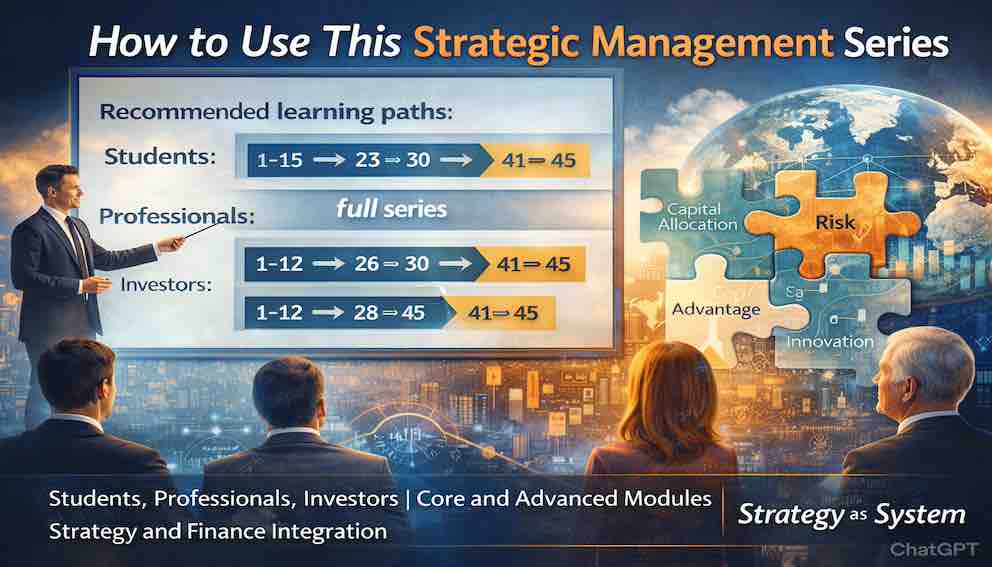
Why do some companies shape the future while others are crushed by it? Why does a brilliant product fail while a simpler one creates an empire? This tutorial introduces the full Strategic Management series, designed for students, professionals, and investors. You will learn who this series is for, how to navigate core and advanced modules, and recommended learning paths tailored to your goals. Beyond frameworks, the series emphasizes that strategy is a living system, integrating analysis, choice, execution, evaluation, and financial reasoning. Practical examples and actionable guidance show you how to extract maximum value and apply insights in the real world.
Introduction: Why Strategy Matters
Why do some companies shape the future while others are crushed by it? Why can a brilliant product fail while a simpler, well-positioned one creates an empire? Why do two competitors in the same industry, with access to the same talent and capital, produce wildly different results over a decade?
The answer is not luck. It is not harder work. It is not even better technology. The difference is strategy.
Strategy is the invisible architecture that guides success. It decides which opportunities a company seizes, which it declines, and how it allocates its finite resources over time. It shapes the way competitors are engaged, value is captured, and capabilities are developed. Without a coherent strategy, even talented organizations drift. With it, ordinary resources can produce extraordinary outcomes.
Whether you are a student seeking to understand business logic, a professional moving from task execution to shaping organizational direction, or an investor aiming to see beyond the numbers to the underlying drivers of value—this series is for you.
This introductory tutorial serves as your compass. It will orient you to the structure of the series, explain its rationale, and help you chart a personalized learning path. By the end, you will understand how to navigate the series and what you will gain from completing it.
Who This Series Is For
Strategic thinking is not one-size-fits-all. A student, a professional, and an investor all require different insights, applications, and perspectives. This series is designed to respect those differences.
Students
If you are studying business, finance, or management, this series functions as your core curriculum. It builds foundational knowledge while connecting concepts to practical application. You will gain more than memorized frameworks; you will understand how companies actually make choices, how competitive dynamics unfold in real markets, and how textbook theory translates into boardroom decisions.
The sequence is designed for gradual mastery. You start with core concepts, progress to analytical tools, and later explore complex topics such as mergers, valuation, and corporate governance. By the end, you will not just know the frameworks—you will be able to wield them.
Think of this as building the foundation of a house before furnishing it. You cannot truly appreciate the rooms without a solid structure underneath.
Professionals
For professionals, this series offers a bridge between experience and systematic knowledge. You may have led teams, managed budgets, or contributed to strategic planning, but without a structured lens, experience can remain anecdotal.
This series helps you formalize intuition, sharpening your ability to assess strategic choices critically, challenge assumptions with evidence, and communicate confidently with executives and stakeholders. Even revisiting familiar concepts can reveal hidden insights when placed in a structured, systemic framework.
Investors
Investors approach strategy from a uniquely financial perspective: strategy determines value. Financial statements reflect the past. Strategy reveals the drivers of future performance.
A company with strong profits but weakening strategic positioning may be a hidden risk. A firm with modest earnings but a durable competitive advantage may be a hidden gem. This series equips you to see these differences, linking strategic quality to financial outcomes, including ROIC, WACC, and valuation multiples.
By the end, you will evaluate companies the way the best investors do—from the inside out, combining qualitative insight with quantitative analysis.
Core vs Advanced: How the Series Is Structured
This series is designed to accommodate multiple levels of prior knowledge and learning goals. Every tutorial is self-contained, providing value individually. But following the recommended sequence allows cumulative understanding: each tutorial builds on the last.
Core Modules
Core tutorials cover the essential foundations of strategic thinking. These modules provide the vocabulary, frameworks, and mental models you will rely on throughout the series. Topics include:
- What strategy actually is, and why most “strategies” fail
- How industries shape the profit potential of companies within them
- How internal capabilities create durable advantage
- Business model innovation for competitive edge
- Differentiating corporate strategy from business strategy
Advanced Modules
Advanced tutorials explore specialized topics and contemporary challenges, such as:
- Emergent strategy and adaptation under uncertainty
- Strategic risk management and scenario planning
- Stakeholder politics, human dynamics, and organizational behavior
- ESG, sustainability, and the strategic license to operate
- Platform ecosystems and winner-take-all dynamics
- AI and data as sources of competitive advantage
- Integration of strategy and corporate finance
These modules show how theory meets the complex reality of modern business.
Strategy Is a System, Not a Set of Tools
Understanding a car by only examining tires, brakes, and steering is insufficient. You see the parts but miss the whole. The same mistake is common in strategy.
Many learners treat frameworks like SWOT, Porter’s Five Forces, or Value Chain as strategy itself, but they are diagnostic tools. They help you analyze, not dictate, strategy.
Strategy as a System
One of the most important insights you will gain in this series is that strategy is not a collection of isolated tools or checklists. It is a living, interconnected system where each decision influences others. Understanding this systemic nature is essential for both making strategy and evaluating it. Let’s break this down step by step:
External Analysis Shapes Capabilities: A company cannot build sustainable advantage in a vacuum. By carefully analyzing competitors, customers, market trends, and macroeconomic forces, a firm identifies the areas where it needs to excel. For instance, Tesla observed the early limitations in battery technology and customer demand for electric vehicles. This external insight shaped the capabilities it needed—high-performance batteries, software integration, and scalable manufacturing.
Capabilities Define Strategic Moves: Once the required capabilities are understood, the organization must ask: what moves are credible? Apple’s design and user experience capabilities allowed it to enter multiple product categories—iPhone, iPad, Apple Watch—while maintaining brand coherence. A company cannot promise innovation it cannot deliver, and understanding capabilities ensures strategic choices are realistic.
Strategic Choices Guide Resource Allocation: After defining the moves, a company must decide where to allocate resources—time, capital, people. Choices are always a trade-off because resources are finite. Amazon, for example, invests heavily in logistics and cloud infrastructure, which supports both retail growth and Amazon Web Services, reinforcing its long-term competitive advantage.
Resource Allocation Influences Culture and Execution: How a company distributes resources shapes behavior and culture. Teams know what matters based on where investment goes. A cost-leadership strategy will fail if operations teams lack the tools or incentives to improve efficiency. Conversely, a differentiation strategy will struggle if marketing, product, and R&D are misaligned. Resource allocation is the bridge between strategy on paper and execution in reality.
Execution Generates Feedback for Strategy Revision: Strategy is not static. Execution produces outcomes that reveal what works and what doesn’t. Companies must collect feedback, interpret it, and adjust accordingly. Kodak’s delayed response to digital photography is a cautionary example: execution revealed that the old film-based strategy was no longer viable, but adaptation came too late. In contrast, Amazon constantly iterates its business model based on execution data, enabling agility and resilience.
Every part of the system interacts with every other. A cost-leadership plan fails if process and technology investments lag behind goals. A product-differentiation strategy flounders if organizational alignment or customer experience does not support the promise. Strategy is therefore not a series of checkboxes; it is a dynamic, continuous loop where analysis, capability-building, decision-making, resource allocation, and execution feed into each other.
Throughout this series, we will treat strategy as a living, dynamic system, illustrating these interactions with real-world examples from Apple, Tesla, Amazon, as well as cautionary lessons from Kodak, Nokia, and others. By seeing strategy in this holistic way, you will learn not just what companies do, but why their decisions succeed—or fail—in the market.
Emergent vs Deliberate Strategy
Strategy is rarely purely planned or purely reactive—it exists on a spectrum between deliberate and emergent approaches. Deliberate strategy involves top-down planning, clear objectives, and structured execution, ensuring resources are aligned with intended goals. Emergent strategy, on the other hand, evolves in response to feedback, experimentation, and changes in the environment, allowing companies to learn, adapt, and seize unexpected opportunities. In practice, the most successful organizations combine both: they set a clear strategic direction, then continuously test hypotheses, track progress through KPIs and OKRs, and adapt dynamically as new insights emerge.
Integrating Strategy and Finance
Strategy without finance is vision without feasibility. Finance without strategy is numbers without context. This series integrates them explicitly:
- Competitive advantage → ROIC impact
- Diversification → cash flow and capital allocation implications
- Investment decisions → expected returns vs cost of capital
By the end, you will evaluate strategic choices quantitatively and qualitatively, understanding both their feasibility and potential impact.
Tips for Getting the Most Out of This Series
Take Your Time – Don’t rush through tutorials. Pause after each framework, reflect on its meaning, and think about how it applies to real-world companies or situations you know.
Apply Immediately – As soon as you learn a concept, like VRIO analysis or Porter’s Five Forces, try applying it to a familiar business. Testing ideas in practice helps turn theory into actionable insight.
Use Examples Liberally – Ground abstract ideas in concrete cases. Companies like Netflix, Apple, Microsoft, and Tesla illustrate how strategic choices play out in real markets. Observing them makes the concepts vivid and memorable.
Take Notes Your Way – Record insights in a format that works for you. Sketch frameworks, summarize key points, or jot questions—these notes become a personal reference library for future tutorials.
Connect Concepts Across Tutorials – Strategy is interconnected. Continuously relate new concepts to what you’ve already learned and think ahead to how they will connect with upcoming tutorials.
What You Will Gain
By completing this series, you will develop a strategic operating system for your mind, capable of:
- Seeing hidden logic in competition
- Distinguishing sustainable advantage from temporary luck
- Connecting high-level choices to operational execution
- Evaluating strategy with qualitative and quantitative insight
- Thinking like leaders and investors who shape the world
This is not just a series of frameworks; it is a systematic, practice-oriented, financially informed lens on strategy.
The journey begins here. Let’s start navigating.
About Swati Sharma
Lead Editor at MyEyze, Economist & Finance Research WriterSwati Sharma is an economist with a Bachelor’s degree in Economics (Honours), CIPD Level 5 certification, and an MBA, and over 18 years of experience across management consulting, investment, and technology organizations. She specializes in research-driven financial education, focusing on economics, markets, and investor behavior, with a passion for making complex financial concepts clear, accurate, and accessible to a broad audience.
Disclaimer
This article is for educational purposes only and should not be interpreted as financial advice. Readers should consult a qualified financial professional before making investment decisions. Assistance from AI-powered generative tools was taken to format and improve language flow. While we strive for accuracy, this content may contain errors or omissions and should be independently verified.