
Tutorial Categories
Last Updated: February 25, 2026 at 10:30
Understanding Strategy: What It Really Means and Why It Matters
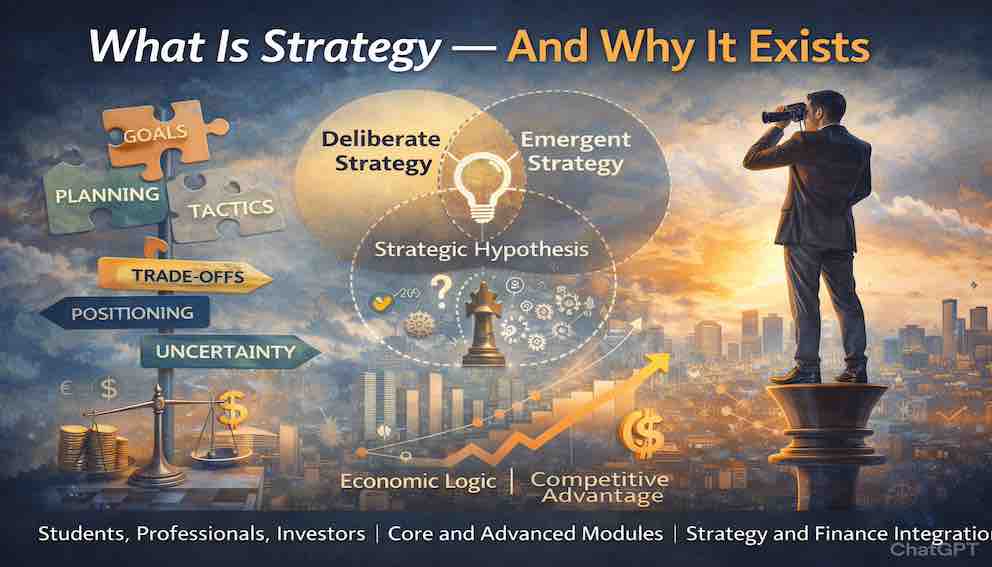
In this tutorial, we explore what strategy truly is, why it goes beyond goals, plans, or tactics, and how it guides the allocation of resources under uncertainty. You will learn why trade-offs are inevitable, how positioning creates opportunity, and how deliberate and emergent strategies interact. Through stories of companies like IKEA, Southwest Airlines, Apple, Netflix, and Tesla, we reveal strategy as a living hypothesis that can be tested and refined. By the end, you will gain a framework for thinking strategically that applies to any organization or market—and you will never read a business headline the same way again.
The Most Misunderstood Word in Business
Imagine walking into a room full of executives and asking a simple question: “What is your strategy?” You would hear many things. Some would describe goals: “We want to grow 20% annually.” Others would mention tactics: “We’re launching a new marketing campaign.” A few might talk about aspirations: “We want to be the most trusted brand in our industry.” Rarely would you hear an actual strategy.
This is not because executives are incompetent. Strategy is simply one of the most misused words in business. It is often applied to everything—from quarterly plans to five-year visions, pricing decisions to cultural values—draining the term of its precise meaning.
This tutorial exists to restore that meaning. Strategy is not a document, a vision statement, or a set of goals. It is a lens through which all business decisions become intelligible, a guiding logic that links choices, trade-offs, and positioning into a coherent system.
The Parable of Two Coffee Shops
Stories often make abstract concepts vivid. Picture this: two coffee shops open on the same street. Both serve coffee at similar prices and employ friendly baristas. Yet one thrives while the other struggles. Why?
The thriving shop observed that most customers arrived between 7:30 and 8:30 a.m.—professionals grabbing coffee on their way to work. It optimized for speed with pre-packaged pastries, an extra espresso machine, and a layout that minimized waiting. The trade-off was clear: it would never be a place where people lingered with laptops for hours. That was acceptable because it was not their customer.
The struggling shop, by contrast, tried to serve everyone: commuters, afternoon laptop users, weekend families, evening study groups. It designed a beautiful, comfortable space and offered elaborate drinks. In trying to appeal to all, it pleased no one completely. The difference was not planning or effort; it was strategy. The thriving shop made coherent choices that reinforced one another, while the struggling shop had goals and tactics but no underlying strategic logic.
What Strategy Is—and What It Is Not
Many people imagine strategy as a detailed plan laid out neatly in a presentation deck. While plans are important, strategy is far deeper. At its core, strategy can be defined as the overarching logic that guides an organization’s choices under uncertainty, aligning resources, capabilities, and actions to create a sustainable advantage in pursuit of desired outcomes. It determines which opportunities are pursued, which trade-offs are accepted, and how all organizational decisions fit together into a coherent system.
To clarify the distinction:
- Strategy is not goals. Goals tell you where you want to go; strategy tells you how to get there, considering your starting point and competitors’ positions.
- Strategy is not tactics. Tactics are the specific actions you take; strategy is the logic that decides which tactics make sense and which would be wasted.
- Strategy is not a vision statement. Vision inspires; strategy decides.
Consider IKEA. Its goals might include increasing revenue by 10% in a year or opening new stores. Tactics could include marketing campaigns or supply chain optimizations. But IKEA’s strategy is a deliberate choice to sell flat-pack, affordable, self-assembled furniture. This choice shapes everything: warehouse locations, logistics, marketing catalogs, in-store experience, and even the inclusion of restaurants with famous meatballs. Every element reinforces the others. That is strategy.
Trade-Offs: What You Choose Not to Do
A hallmark of strategy is the acceptance of trade-offs. Resources—time, money, talent—are finite. Every choice to pursue one opportunity is simultaneously a choice to abandon others. Ignoring trade-offs usually leads to mediocrity.
Take Southwest Airlines. Its strategy is low-cost, point-to-point air travel with minimal frills. This requires deliberate sacrifices: no first-class seating, no meals, no assigned seating, no long-haul international flights. These are not limitations; they are sources of advantage. Eliminating meals speeds boarding and reduces costs. Point-to-point routing simplifies operations. Every "no" strengthens the "yes."
Had Southwest tried to do everything, operational complexity would rise, costs would soar, and its core value proposition—low fares and efficiency—would collapse. Michael Porter called this the “stuck in the middle” problem: companies that refuse trade-offs often fail to differentiate themselves.
Positioning: Where You Choose to Play
Trade-offs are discipline; positioning is creativity. Positioning answers: Where and how will we compete? It shapes the market, customer expectations, and the organization’s identity.
Consider Apple. Its positioning as a premium, design-driven brand allows high pricing, invests in user experience, and creates loyalty. It cedes the low-end market, focusing resources on products that reinforce its identity. Similarly, Toyota emphasizes reliability and efficiency, BMW emphasizes performance, and Tesla emphasizes innovation and technology leadership.
Positioning is powerful because it defines both inclusion and exclusion. By clearly choosing who you will serve and who you will not, you can focus on delivering value in ways competitors cannot easily replicate.
Even in bookstores, positioning makes a difference. Barnes & Noble focused on physical superstores and the in-store experience, while Amazon focused on unlimited selection, low prices, and home delivery. The choices that defined Barnes & Noble’s advantage became constraints when the environment changed. Strategy creates opportunity but also exposure; it is inseparable from risk.
Allocating Resources Under Uncertainty
Strategy is about making choices in an uncertain world. Markets shift, competitors react, technology evolves, and black swan events appear without warning.
Amazon exemplifies this. In the late 1990s, it invested heavily in warehouses, technology, and supply chain systems. These investments depressed profits, yet they were calculated bets: if e-commerce adoption grew, scale created efficiency, and customer experience drove loyalty, these resources would create long-term advantage. When the dot-com crash arrived, Amazon’s deliberate resource allocation enabled survival and subsequent dominance. Strategy provides the logic to allocate scarce resources when the future is unknown.
Deliberate and Emergent Strategy: Planning Meets Adaptation
Not all strategy is deliberate. Emergent strategy arises when organizations discover new opportunities through experimentation, learning, and adaptation.
Netflix illustrates this interplay. The DVD-by-mail service was a deliberate strategy: flat-rate subscription, no late fees, mail delivery. Streaming emerged as bandwidth improved and customer interest became clear. Original content followed as licensing costs rose. Deliberate strategy created the platform; emergent strategy captured new opportunities. Success comes from balancing planned direction with adaptive learning, a dance between intention and discovery.
Strategy as a Hypothesis
Every strategy is a hypothesis: a reasoned guess about how value will be created, tested through execution and refined based on evidence. Tesla exemplifies this. Its strategy assumes that customers will value sustainability, innovation, and technology leadership. The Model S, Model 3, Gigafactory, and charging network are experiments testing this hypothesis. Each result informs the next step. Treating strategy as a living hypothesis encourages humility, measurement, and adaptation.
The Economic Logic of Strategy
The Strategy That Wasn’t:
A large US retail chain in the 2000s expanded rapidly. Revenue grew, but profits fell. Costs outpaced income. Despite coherent plans, trade-offs, and positioning, the strategy failed—it did not create economic value.
Key lesson: Coherence, trade-offs, and adaptation matter—but without measurable outcomes, strategy fails.
Economic logic asks: How does this strategy create value exceeding its cost? Every choice—product, customer, capability—must pass this test. Returns must exceed costs; advantage must be sustainable.
Example: Toyota Production System
- Lean manufacturing reduces waste.
- Just-in-time lowers storage costs.
- Jidoka stops defects.
- Kaizen drives continuous improvements.
Together, these produce measurable results: higher quality, lower costs, customer loyalty, stronger margins. Competitors can copy tools, but the integrated system is hard to replicate. This is sustainable economic logic. Strategy without it is only ambition; with it, strategy is a value-creation engine.
The Strategic Lens
By combining these elements—coherent choices, trade-offs, positioning, deliberate and emergent strategy, hypothesis-testing, and economic logic—we gain a strategic lens. This lens allows us to see the hidden architecture behind organizational success or failure.
- When a company launches a new initiative, we ask: Does this fit the strategic logic, or is it a distraction?
- When a competitor surprises the market, we ask: What hypothesis are they testing? What trade-offs are they accepting?
- When a company struggles despite apparent strengths, we ask: Where is the economic logic breaking down?
- When a company succeeds against expectations, we ask: Is this outperformance sustainable, or will competitors respond?
These questions separate strategic thinking from casual observation. They reveal what is really happening beneath the surface.
Illustrative Company Stories
IKEA: Coherent choices—flat-pack design, warehouse stores, in-store restaurants—reinforce each other. Trade-offs like limited customization strengthen the system.
Southwest Airlines: Discipline in operations—single aircraft type, point-to-point flights, no frills—creates low-cost advantage. Trade-offs are sources of strength.
Apple: Premium, focused positioning enables ecosystem integration, innovation, and customer loyalty. Trade-offs are deliberate.
Amazon: Long-term hypothesis drives investment in scale, infrastructure, and customer experience. Emergent opportunities, like AWS, build on deliberate choices.
Netflix: DVD-by-mail strategy created platform; streaming and original content emerged through experimentation. Deliberate and emergent strategies coexist.
Toyota: Lean manufacturing and continuous improvement embed economic logic that competitors cannot easily replicate. Strategy creates measurable, sustainable value.
Conclusion: Why Strategy Matters
Strategy is not a plan, goal, or vision. It is a framework that aligns choices, trade-offs, and positioning for sustainable advantage. Without it, organizations drift, imitate without insight, and misallocate resources. With it, every decision becomes intelligible, trade-offs are deliberate, positioning is clear, hypotheses are tested, and value is created. These concepts may feel abstract now, but they will become clearer and more practical as we progress through the next chapters, with real-world examples and exercises to bring strategy to life.
Key Takeaways
- Strategy guides choices under uncertainty, distinct from goals, plans, and tactics.
- Trade-offs are essential.
- Positioning defines where and how to compete.
- Strategy helps allocate resources in an unpredictable world.
- Deliberate and emergent strategy coexist.
- Strategy is a hypothesis—test, validate, refine.
- Economic logic links strategy to measurable value.
- The strategic lens reveals the architecture behind success and failure.
About Swati Sharma
Lead Editor at MyEyze, Economist & Finance Research WriterSwati Sharma is an economist with a Bachelor’s degree in Economics (Honours), CIPD Level 5 certification, and an MBA, and over 18 years of experience across management consulting, investment, and technology organizations. She specializes in research-driven financial education, focusing on economics, markets, and investor behavior, with a passion for making complex financial concepts clear, accurate, and accessible to a broad audience.
Disclaimer
This article is for educational purposes only and should not be interpreted as financial advice. Readers should consult a qualified financial professional before making investment decisions. Assistance from AI-powered generative tools was taken to format and improve language flow. While we strive for accuracy, this content may contain errors or omissions and should be independently verified.