Tutorial Categories
Last Updated: February 25, 2026 at 10:30
Understanding the Business Environment: Why Context Is Critical for Strategic Success
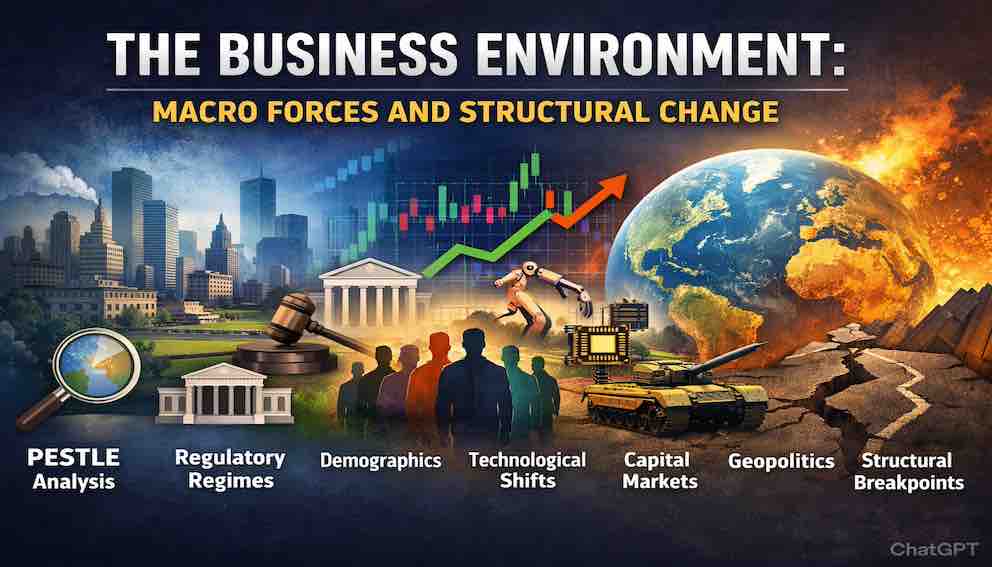
A strategy, no matter how ambitious or well-resourced, only succeeds if it aligns with the environment in which an organization operates. Understanding the business environment—the combination of macro forces, industry dynamics, and hidden breakpoints—is essential to turn strategic intent into actionable results. This tutorial explains why environmental awareness matters, introduces frameworks like PESTLE and SWOT for systematic scanning, and illustrates how structural disruptions create both threats and opportunities. Through case studies—Kodak, Blockbuster, Netflix, Nokia, Apple, Tesla, and Amazon—you will learn how organizations anticipate change, align purpose with reality, and make strategic decisions that work.
Introduction: The Parable of Two Watchmakers
Imagine two watchmakers in Switzerland in the 1970s. Both were skilled artisans with loyal customers and a passion for quality.
One continued crafting mechanical watches, confident that customers would always value tradition. The other noticed a new technology—quartz—making timekeeping more accurate and cheaper.
Within a decade, the first struggled. The second thrived.
Neither changed their internal capabilities. Both faced the same external world. The difference was in what they saw—and how they acted.
Lesson: Internal excellence cannot compensate for misreading the external environment. Strategy is only effective when it aligns with reality.
Why Strategy Must Respond to the World Outside
Organizations often focus heavily on internal ambitions, resources, and capabilities. Mission statements clarify purpose, vision outlines long-term aspiration, and strategic intent defines direction. These are essential—but insufficient on their own.
Strategy operates within a complex, shifting environment. Ignoring external forces can render even the most brilliant strategies ineffective.
Kodak: A Cautionary Tale
Kodak led global photography for decades. In 1975, engineer Steve Sasson invented the first digital camera. Leadership recognized the innovation but feared it would cannibalize film sales. Strategy remained anchored to a declining world.
Kodak had the technology and talent but failed to see the emerging environment. By the time it pivoted, the market had moved on.
Insight: Strategy must reflect both internal capabilities and external realities.
Layers of the Business Environment
When we talk about “the environment,” it can sound abstract — almost like background noise. But in strategy, the environment is not background. It is the terrain on which every decision is made.
An organization does not operate in isolation. It lives inside a system of forces, pressures, and movements that constantly shape what is possible, profitable, and sustainable.
To make sense of this complexity, it helps to think of the business environment as three interconnected layers.
Let’s move through them slowly.
1️⃣ The Outer Layer: Macro Forces
The first layer is the broadest. These are large-scale forces that affect entire industries — sometimes entire countries — at once. Individual companies cannot control them. But they must understand them.
Think of this layer as the weather system of the economy.
- Political forces include government stability, trade agreements, taxation policies, and industrial support. A subsidy can make a new industry viable overnight. A tariff can destroy margins just as quickly.
- Economic forces shape purchasing power and investment. Interest rates affect borrowing costs. Inflation affects consumer confidence. A recession changes what customers value.
- Social forces reflect how people live, think, and behave. Demographic shifts, cultural values, and lifestyle trends alter demand patterns. What one generation values, another may ignore.
- Technological forces reshape how products are built, delivered, and consumed. Innovations can lower costs, create new markets, or render existing models obsolete.
- Legal forces define the rules of the game. Regulation can protect consumers, increase compliance costs, or create barriers to entry.
- Environmental forces reflect growing attention to sustainability, climate impact, and responsible resource use. These are no longer peripheral concerns; they influence investor expectations and customer loyalty.
Macro forces are slow-moving in some periods and explosive in others. They rarely announce themselves clearly. But they always matter.
2️⃣ The Middle Layer: Industry Structure
If macro forces are the weather, industry structure is the landscape.
This layer determines how profits are distributed within a particular sector. Two industries operating under the same macro conditions can have completely different profit dynamics because their structures differ.
Here we look at questions such as:
- How intense is competition? Are there many players fighting aggressively, or a few stable leaders?
- How much power do customers have? Can they easily switch to alternatives?
- How much power do suppliers have? Are critical inputs controlled by a few firms?
- How difficult is it for new competitors to enter?
- Are there substitute products that could replace the industry altogether?
Industry structure explains why some sectors consistently earn high returns while others struggle, even when the economy is strong.
Understanding this layer helps leaders avoid blaming “bad execution” for what may actually be structural pressure.
3️⃣ The Inner Layer: Hidden Breakpoints
The third layer is the most subtle — and often the most dangerous.
Hidden breakpoints are small disruptions that, at first glance, seem minor. A regulatory adjustment. A technological experiment. A geopolitical tension. A quiet shift in consumer behavior.
Individually, they may appear manageable.
Collectively, they can transform an industry.
A new regulation can alter cost structures.
A breakthrough technology can redefine customer expectations.
A geopolitical event can disrupt supply chains overnight.
A behavioral shift — such as preferring convenience over ownership — can reshape entire business models.
Breakpoints are rarely obvious in their early stages. They appear as weak signals, not headlines. But once they cross a tipping point, the industry looks different.
Why This Matters
These three layers are interconnected. Macro forces shape industry structure. Industry structure amplifies or dampens breakpoints. Breakpoints, in turn, can reshape the structure entirely.
Strategic advantage often comes not from reacting faster after change is obvious, but from recognizing early signs before competitors do.
Early detection creates room to adapt.
Missing those signals can lead to gradual irrelevance — not because the organization lacked talent or resources, but because it misread the terrain.
Strategy, at its core, is not just about ambition. It is about understanding the world clearly enough to act wisely within it.
Case Studies: Reading the Environment
Blockbuster vs. Netflix
Blockbuster dominated video rentals in the late 1990s. Netflix launched in 1997 with DVD-by-mail subscriptions.
Blockbuster misread:
- Technology: Physical rentals would last; streaming ignored
- Social: Consumers valued convenience over browsing
- Competitive leverage: Store network was a liability, not an asset
Netflix, by contrast, anticipated behavioral and technological shifts, investing early in streaming. Blockbuster filed for bankruptcy in 2010.
Insight: Success depends on reading multiple environmental dimensions before opportunities or threats fully materialize.
Nokia and Apple
Before 2007, Nokia and BlackBerry led mobile phones. Apple introduced the iPhone, creating a structural breakpoint: phones as pocket computers with software-driven ecosystems.
Nokia and BlackBerry saw the device but not the disruption. Apple and Samsung adapted and captured enormous value.
Insight: Breakpoints often arise outside the industry. Watching only direct competitors can be fatal.
Tools for Systematic Environmental Analysis
When leaders say, “We are watching the environment,” the question is: How?
Without structure, environmental analysis becomes scattered observation. With structure, it becomes disciplined thinking.
One of the most practical tools for this is PESTLE analysis.
PESTLE Analysis
PESTLE helps organizations scan the macro environment systematically. It reminds leaders to look beyond competitors and examine six broad forces: Political, Economic, Social, Technological, Legal, and Environmental.
The purpose is not to predict the future perfectly. It is to reduce blind spots — to anticipate threats early and recognize opportunities before they become obvious.
Let’s apply it carefully to a real transformation: the rise of electric vehicles.
Example: Electric Vehicles
Political:
Governments across Europe, China, and parts of the United States began offering subsidies for electric vehicle purchases while simultaneously announcing future bans on internal combustion engines. These policies did not just encourage EV adoption — they signaled that the long-term direction of transportation policy was shifting. Companies that paid attention understood that regulatory momentum was not temporary; it was structural.
Economic:
Fuel prices, interest rates, and access to financing influence consumer purchasing decisions. As battery costs declined and scale improved, the total cost of owning an electric vehicle became increasingly competitive with gasoline cars. Companies that recognized this economic inflection point saw that EVs were moving from niche luxury to mass-market viability.
Social:
Consumer attitudes toward sustainability evolved significantly over the past decade. For many buyers, owning an electric vehicle became a statement about environmental responsibility and technological sophistication. Social perception shifted from “experimental” to “aspirational,” expanding demand beyond early adopters.
Technological:
Breakthroughs in battery efficiency, range improvements, and charging infrastructure dramatically increased practicality. At the same time, software integration transformed vehicles into connected devices rather than purely mechanical machines. Companies that invested early in battery research and digital ecosystems positioned themselves ahead of slower-moving competitors.
Legal:
Emissions standards tightened across major markets, increasing compliance costs for traditional automakers. Safety and manufacturing regulations also evolved to address battery systems and autonomous features. Legal shifts reshaped cost structures and forced incumbents to accelerate EV development, even if they were initially hesitant.
Environmental:
Climate change concerns intensified public and investor scrutiny of carbon-intensive industries. Resource constraints and sustainability reporting requirements pushed companies to rethink supply chains and production methods. Environmental pressure was not just ethical — it became financial and reputational.
The Strategic Implication
Tesla did not simply build an electric car. It aligned its strategy with the direction of political policy, economic viability, social sentiment, technological progress, legal pressure, and environmental urgency.
In other words, it read the macro environment as a coordinated movement — not as isolated trends.
That is the real power of PESTLE: it transforms scattered signals into structured insight, allowing strategy to move with the current of change rather than against it.
Linking PESTLE to SWOT
PESTLE helps you understand what is happening outside the organization. SWOT forces you to connect those external insights to what is happening inside the organization.
In simple terms, PESTLE identifies the forces shaping the environment, while SWOT translates those forces into strategic implications.
- Strengths and Weaknesses are internal. They reflect what the organization can do well — and where it is constrained.
- Opportunities and Threats are external. They often emerge directly from PESTLE analysis — regulatory changes, social shifts, technological advances, or economic pressures.
The power of SWOT lies in alignment. An external opportunity only matters if the organization has the internal strength to capture it. Likewise, a threat becomes dangerous when it collides with an internal weakness.
Example: Netflix and Blockbuster
The rise of streaming technology was an external opportunity identified through technological and social trends. Netflix had built digital infrastructure, subscription billing systems, and data-driven recommendation capabilities — internal strengths that allowed it to capitalize on that opportunity.
Blockbuster saw the same technological shift, but its core strength was a nationwide network of physical stores — which became a structural weakness in a streaming world. The opportunity existed for both, but only one had the internal alignment to act on it effectively.
Additional Practical Tools
Environmental awareness is not a one-time exercise. It must become a habit. Several tools help organizations move from occasional analysis to continuous strategic vigilance.
Scenario Planning:
Scenario planning tests strategies against multiple plausible futures rather than relying on a single forecast. For example, companies like Shell developed alternative energy scenarios after experiencing oil shocks, preparing for volatility instead of assuming stability. This approach reduces strategic rigidity and increases resilience.
Environmental Scanning:
Environmental scanning formalizes the process of monitoring political, economic, technological, and social developments. Instead of reacting to headlines, organizations assign responsibility for tracking trends and reporting implications regularly. This transforms awareness from intuition into institutional discipline.
Weak Signal Detection:
Weak signals are early indicators of change that appear small or fringe at first — emerging startups, niche consumer behaviors, experimental technologies. Paying attention to these signals allows firms to identify breakpoints before they become mainstream. By the time a trend is obvious, it is often too late to build advantage.
Red Teaming:
Red teaming involves deliberately challenging core assumptions. A designated group questions strategy, stress-tests decisions, and asks, “What if we are wrong?” This process uncovers blind spots and forces leaders to confront uncomfortable but necessary possibilities.
- Together, these tools ensure that environmental analysis is not theoretical. They make strategy dynamic — constantly informed by reality, continuously tested against change.
Why Environmental Understanding Matters
Understanding the environment is not an academic exercise. It directly shapes the quality of strategic decisions. When leaders see clearly, they act differently — earlier, more deliberately, and with fewer surprises.
Let us unpack what that really means.
Anticipating Risk (e.g., Brexit preparations):
When the United Kingdom voted to leave the European Union, companies that had already mapped regulatory and trade dependencies were able to adjust supply chains, legal structures, and currency exposure more quickly. Those that had treated political risk as remote were forced into reactive decisions. Environmental awareness does not eliminate uncertainty, but it reduces shock.
Spotting Opportunities (e.g., AWS from excess server capacity):
Amazon noticed that its growing e-commerce infrastructure had created excess computing capacity. At the same time, startups were struggling with the cost of building their own servers. By recognizing this technological and economic gap, Amazon transformed an internal capability into Amazon Web Services — a new business model born from environmental insight.
Aligning Resources:
Capital and talent are limited. Environmental understanding helps leaders invest where external trends support growth rather than resist it. Instead of spreading resources evenly, strategy concentrates them where long-term value creation is structurally favored.
Building Flexibility:
When organizations understand volatility in advance, they design systems that can adapt. This might mean diversified suppliers, modular production systems, or contingency financial reserves. Flexibility is not accidental; it is built intentionally in response to environmental uncertainty.
Strengthening Negotiation:
Awareness of regulatory shifts, competitive pressures, and market dynamics improves bargaining power. A firm that understands how policy or competition may evolve can structure contracts, partnerships, and alliances with foresight rather than optimism. Information asymmetry often determines negotiating strength.
Integrating Purpose, Intent, and Environmental Awareness
Purpose gives direction. Environmental awareness provides boundaries and opportunities. Strategy succeeds when the two move together.
Tesla illustrates this alignment clearly. Its purpose-driven focus on accelerating sustainable energy matched political subsidies, social climate awareness, technological battery advances, tightening emissions regulations, and environmental urgency. The company’s internal mission did not fight the external environment — it rode the wave of it.
Amazon offers a different but equally powerful example. Its culture of operational efficiency and technological experimentation aligned with rising internet adoption, falling computing costs, and the growing need for scalable digital infrastructure. AWS was not just a technical innovation; it was a strategic response to broader economic and technological forces.
When internal purpose ignores external reality, the outcome is often decline. In the 1970s, segments of the American auto industry remained committed to large, fuel-intensive vehicles even as oil shocks and consumer preferences shifted toward efficiency. The strategy reflected internal legacy strengths more than external change — and competitors capitalized on that gap.
Key Insight
Strategy is not pure ambition, nor is it passive adaptation.
It is a continuous dialogue between what an organization aspires to become and what the external world will reward.
When aspiration and reality align, strategy compounds.
When they diverge, even strong organizations struggle.
Conclusion: Strategy as Continuous Dialogue
- Macro forces set context; PESTLE structures their analysis
- Industry structure shapes competitive potential
- Breakpoints transform industries; early detection creates advantage
- SWOT links external factors to internal capabilities for actionable strategy
- Continuous scanning and analysis build environmental awareness
- Success lies at the intersection of what an organization wants and what the world will reward
In the next tutorial, we will dive deep into industry structure. You will learn Porter's Five Forces framework—how to use it, where it falls short, and how to assess the true profit potential of any competitive landscape.
Key Takeaways:
- Internal clarity is necessary but insufficient; environmental awareness is critical
- Macro forces, industry structure, and breakpoints require systematic attention
- PESTLE and SWOT together bridge external observation and strategic action
- Tools like scenario planning, scanning, weak signal detection, and red teaming institutionalize awareness
- Case studies illustrate how alignment between purpose, capability, and environment determines success
About Swati Sharma
Lead Editor at MyEyze, Economist & Finance Research WriterSwati Sharma is an economist with a Bachelor’s degree in Economics (Honours), CIPD Level 5 certification, and an MBA, and over 18 years of experience across management consulting, investment, and technology organizations. She specializes in research-driven financial education, focusing on economics, markets, and investor behavior, with a passion for making complex financial concepts clear, accurate, and accessible to a broad audience.
Disclaimer
This article is for educational purposes only and should not be interpreted as financial advice. Readers should consult a qualified financial professional before making investment decisions. Assistance from AI-powered generative tools was taken to format and improve language flow. While we strive for accuracy, this content may contain errors or omissions and should be independently verified.