
Tutorial Categories
Last Updated: February 25, 2026 at 10:30
Strategic Purpose: Mission, Vision, and Strategic Intent to Drive Organizational Success
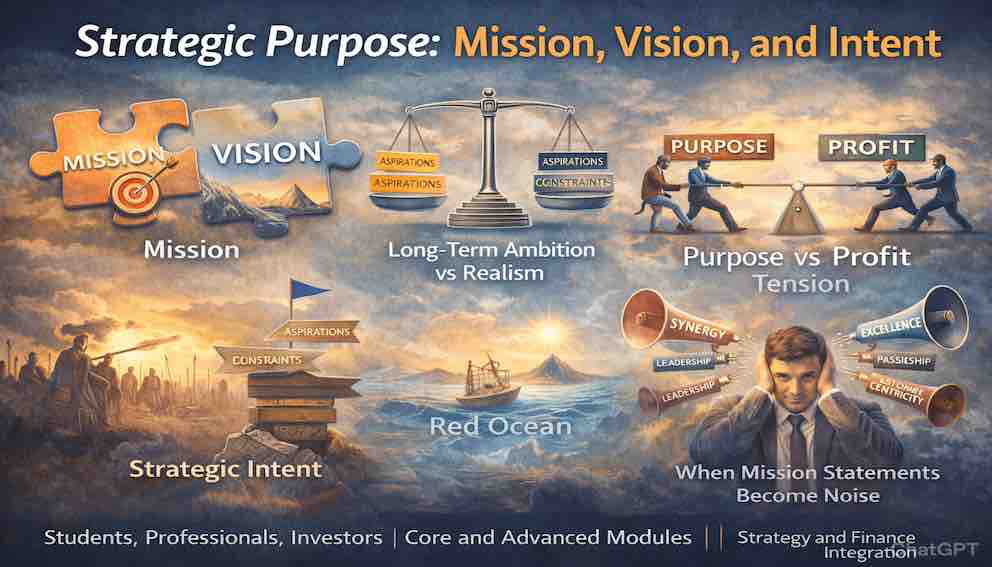
Every organization needs a reason for being that goes beyond generating profit. In this tutorial, we explore the difference between mission and vision, the role of strategic intent, and how leaders balance ambition with realism while navigating the tension between purpose and profit. Through stories of companies like Tesla, Patagonia, Apple, SpaceX, IKEA, Intel, and Unilever, we demonstrate how a compelling purpose transforms abstract strategy into concrete, actionable outcomes—and why poorly crafted mission statements fail to inspire or guide. By the end, you will understand not just how to articulate a mission statement, but how to ensure strategic purpose genuinely shapes organizational decisions, culture, and long-term impact.
Introduction: The Question Behind Every Strategy
Imagine two companies in the same industry. Both have access to the same talent, the same capital, the same technology. Both analyze their markets using similar frameworks. Both create detailed strategic plans.
Ten years later, one has transformed its industry and inspired millions. The other struggles to survive.
What explains the difference?
The answer lies beneath the surface of plans and frameworks. It lies in something more fundamental than analysis or execution. It lies in purpose—the answer to a simple question that too few organizations ask honestly:
Why do we exist?
Strategy tells you how to compete. Purpose tells you why competing matters. Without purpose, even the most sophisticated strategy becomes a collection of disconnected actions, lacking coherence or direction. With purpose, every decision gains meaning, every trade-off becomes intelligible, and every employee understands not just what to do, but why it matters.
This tutorial explores the foundational elements of strategic purpose: mission, vision, and strategic intent. These are not merely statements to be printed on posters and forgotten. They are the gravitational center around which everything else orbits.
The Parable of the Three Builders
There is an old story that captures the difference between having a task and having a purpose.
Three workers are carving stone at a construction site. A passerby asks each what they are doing.
- The first says, "I am cutting this stone to exact dimensions. It is hard work, but I am skilled at it."
- The second says, "I am building a wall. When it is finished, it will stand for generations."
- The third says, "I am building a cathedral. When it is complete, people will come here to find peace, to celebrate joy, to mark the most important moments of their lives. Generations yet unborn will walk through these doors and feel something greater than themselves."
All three are doing the same work. Only one has purpose.
Strategic purpose transforms stone-cutting into cathedral-building. It turns daily tasks into contributions to something larger. In other words, it answers the fundamental question that every employee, customer, and investor eventually asks when interacting with an organization: Why should I care about what this company does? Purpose makes strategy meaningful to the people whose engagement determines its success.
Why Purpose Matters Before Strategy
Before diving into definitions, frameworks, or strategic models, it is crucial to understand why purpose is not just a nice-to-have, but a strategic necessity. Purpose shapes decisions, motivates people, and guides organizations when the path is uncertain. Consider these five ways in which purpose drives organizational success, illustrated with real-world examples.
1. Purpose Provides Coherence
Without a clear sense of why the organization exists, decisions become fragmented. Marketing may pursue one initiative, product development another, and sales a third. Resources are wasted on efforts that pull in different directions.
Example: Imagine a technology startup with engineers excited about creating cutting-edge AI features, while marketing is focused on budget-friendly offerings, and sales pushes for premium enterprise contracts. Without a unifying purpose, the teams will pull in different directions, resulting in inefficiency and confusion. By contrast, a company like Apple, with its purpose of designing products that enrich people’s lives through seamless technology, ensures that product features, advertising campaigns, and store experiences all reinforce the same underlying goal. Everyone knows what matters, and coherence emerges naturally.
2. Purpose Enables Trade-offs
Strategy always involves choosing what not to do. These decisions can be painful unless there is a clear guiding principle. Purpose provides that basis. When faced with two attractive opportunities, asking, “Which better serves our purpose?” clarifies the path.
Example: Consider Tesla in its early years. The company faced a choice: expand quickly into mass-market cars, or focus on perfecting high-performance electric vehicles first. Purpose—to accelerate the world’s transition to sustainable energy—made the decision obvious: focus first on creating desirable electric cars that prove the technology works and inspire the market. The trade-off meant short-term revenue was delayed, but it aligned perfectly with their purpose.
3. Purpose Motivates Beyond Money
Financial incentives alone rarely inspire extraordinary effort. People want to feel that their work matters. Purpose connects daily tasks to something larger than quarterly bonuses or profit margins.
Example: At SpaceX, engineers endure long hours and intense challenges not primarily for salary, but because the company’s purpose—making humans a multi-planetary species—is compelling. Every line of code, every rocket test, every failure teaches something toward that larger goal. Employees feel part of a mission bigger than themselves, and that motivates persistence and creativity even under extreme pressure.
4. Purpose Attracts and Retains Talent
The most capable people have choices. They increasingly seek organizations whose purpose aligns with their values. Purpose becomes a competitive advantage in the war for talent.
Example: Patagonia is renowned not just for its products, but for attracting employees who genuinely care about environmental sustainability. People stay because the work aligns with their values—whether it’s developing eco-friendly materials, repairing used clothing, or running campaigns to protect public lands. The company doesn’t just offer a job; it offers meaningful engagement with a cause. This creates a deeply committed workforce that competitors struggle to match.
5. Purpose Builds Customer Loyalty
Customers are not just rational calculators of price and features. They are human beings who want to associate with organizations that stand for something. Purpose creates emotional connection that transactions alone cannot.
Example: Patagonia again provides a striking illustration. Its mission—“We're in business to save our home planet”—shapes every operational and marketing choice. Customers see that buying Patagonia products contributes to environmental protection, whether through donations, sustainable materials, or repair programs. People are willing to pay a premium because they feel part of the mission, not just because of product quality. In this way, purpose itself becomes a driver of loyalty and long-term revenue.
Key Takeaway:
Purpose is not abstract fluff—it is a practical tool that aligns teams, clarifies trade-offs, motivates employees, attracts talent, and creates deep connections with customers. Companies like Apple, Tesla, SpaceX, and Patagonia show that when purpose is authentic and embedded in decisions, it becomes a competitive advantage. In essence, for these organizations, the purpose is the strategy.
Mission and Vision: Two Sides of Strategic Purpose
One of the most fundamental distinctions in strategic thinking is between mission and vision. While the terms are often used interchangeably in everyday conversation, they serve very different functions.
Mission: The Present Purpose
Mission defines the organization’s reason for existence in the present. It answers: What do we do? For whom? Why does it matter? A clear mission grounds strategy in reality, ensuring that efforts are connected to actual capabilities and market needs.
Characteristics of a Good Mission Statement:
- Specific enough to guide decisions. ("Making people happy" is too vague; "Providing affordable, flat-pack furniture that makes good design accessible to everyone" is actionable.)
- Identifies the primary customer or beneficiary.
- Articulates the unique value provided.
- Grounded in current capabilities, not aspirations alone.
Example: World Health Organization
"To promote health, keep the world safe, and serve the vulnerable." Every program, partnership, and allocation of resources can be evaluated against this mission.
Vision: The Future Aspiration
Vision describes a desired future state—an aspirational picture of where the organization wants to be. A compelling vision inspires, communicates ambition, and provides a long-term horizon for planning.
Characteristics of a Powerful Vision:
- Aspirational and worth striving for.
- Provides direction without specifying every step (compass, not map).
- Resonates emotionally.
- Stable over time.
Example: Amazon
"To be Earth's most customer-centric company." This vision does not specify operational details but sets a clear direction: every decision is filtered by whether it makes the company more customer-centric.
The Dance Between Mission and Vision
Mission grounds the organization in reality; vision pulls it forward. The best organizations manage both simultaneously: deeply rooted in what they do today, relentlessly reaching toward what they could become tomorrow.
How Different Visions Create Different Strategies
Different visions naturally lead to different strategies, even for companies in the same industry.
- Company A’s vision: Become the global leader in affordable internal combustion engine vehicles.
- Company B’s vision: Pioneer sustainable, fully electric mobility solutions worldwide.
These visions result in fundamentally different choices:
- R&D focus: incremental engine efficiency vs. battery and electric powertrain breakthroughs
- Supply chain: optimize traditional components vs. secure rare earths and battery capacity
- Manufacturing: improve existing assembly lines vs. retool factories for new processes
- Marketing: reliability and fuel efficiency vs. innovation, sustainability, and tech leadership
- Partnerships: traditional suppliers vs. charging infrastructure and battery manufacturers
- Time horizon: short-term market share vs. long-term industry transformation
Vision determines which game you are playing, and the choice of game matters more than tactical advantages within the game.
Strategic Intent: Bridging Ambition and Action
Mission defines the present; vision sets the future. Strategic intent is the bridge between the two. It is a statement of focused, ambitious goals that mobilizes resources, guides decisions, and communicates priorities across the organization.
Characteristics of Effective Strategic Intent:
- Ambitious but achievable: stretches the organization without breaking it.
- Focused: identifies a small number of priorities.
- Stable but adaptable: guides long-term direction while allowing tactical flexibility.
- Communicated relentlessly: every employee knows and understands it.
Example: Intel
In the 1980s, Intel articulated a strategic intent to "focus relentlessly on being the best memory company in the world." This goal guided investments, aligned employees, and created organizational learning. Later, as the memory business declined, Intel shifted its intent to microprocessors—a smooth transition enabled by the discipline of strategic intent.
When Mission Statements Fail
Most mission statements do not fail because they are poorly written.
They fail because they are never truly used.
The first failure is the generic trap.
Phrases like “We strive for excellence” or “Customer satisfaction is our priority” sound positive. But they are interchangeable. Every organization claims excellence. Every organization claims to care about customers. If a statement could belong to any company in any industry, it provides no direction. It does not force trade-offs. It does not guide difficult choices. It simply fills space.
The second failure is the compliance exercise.
A board asks for a mission statement. A consulting firm drafts one. Marketing polishes the language. Posters are printed. The website is updated. Then everyone returns to business as usual. The statement exists—but it does not shape hiring, product design, capital allocation, or strategy. Employees quickly sense that it is symbolic rather than operational.
The third failure is the most damaging: the credibility gap.
An organization declares that it values sustainability, integrity, or customer trust—yet behaves in ways that contradict those claims. Leaders speak of long-term impact while chasing short-term earnings at any cost. Employees and customers notice the inconsistency. Cynicism grows. Once trust erodes, even a well-written mission becomes meaningless.
Mission statements fail, in short, when they are decorative rather than decisive.
What Actually Works
A mission begins to matter when it is created with participation, not imposed from above. When people are involved in shaping it, they are more likely to internalize it. They see themselves in it.
It works when the mission is linked to real decisions.
If a new opportunity arises, leaders should be able to ask, “Does this advance our mission?”—and mean it. If the answer is no, the opportunity is declined. That is when employees realize the mission has weight.
It works when choices are consistently evaluated through a mission lens. Over time, patterns form. Hiring decisions align with it. Investment priorities reflect it. Incentives reinforce it. Culture begins to mirror it.
It works when leaders live the purpose publicly. Employees watch behavior more closely than they read statements. When leaders make visible sacrifices to uphold the mission, credibility strengthens.
And finally, it works when the mission is revisited thoughtfully. Not rewritten every year to follow trends, but refreshed when the organization evolves. A mission should be stable enough to provide direction, yet flexible enough to remain relevant.
When these conditions are met, a mission statement stops being a paragraph on a website. It becomes a compass.
The Tension Between Purpose and Profit
Balancing mission and profit is a central challenge.
Short-term trap: Quarterly earnings pressures can erode purpose.
- Example: Unilever – Sustainable Living Plan aimed to improve health, reduce environmental impact, and enhance livelihoods. Costly short-term investments were justified by long-term alignment with purpose.
- Example: Patagonia – Purpose takes precedence over profit. Radical actions like the "Don't Buy This Jacket" campaign reinforce the mission while maintaining financial success.
Leaders navigate this tension by:
- Making trade-offs explicit.
- Communicating logic behind decisions.
- Protecting purpose during difficult times.
- Measuring what matters beyond financial results.
Purpose in Action: Stories That Illustrate
Tesla: Mission drives every decision—patents shared, charging network built, massive factories scaled—because accelerating sustainable energy matters more than short-term profit.
IKEA: Purpose manifests in flat-pack designs, warehouse placement, in-store meals, functional design, and sustainability initiatives. Employees and customers experience purpose in every interaction.
SpaceX: Vision drives radical innovation—reusable rockets, in-house manufacturing, tolerance for failure—all in service of enabling humanity to become multi-planetary.
Patagonia: Purpose shapes identity—campaigns, Worn Wear, environmental donations—creating loyalty, engagement, and alignment across operations.
Textual Visual: How Purpose Drives Action
Think of purpose as a chain that connects belief to behavior. Each link builds on the previous one.
Mission → Strategic Intent → Vision → Decisions / Actions
Mission: Grounded in Today
The mission explains why the organization exists right now. It is rooted in present reality — current capabilities, current customers, current context. It answers:
What do we do? For whom? Why do we exist?
A strong mission anchors the organization. It prevents drift. It reminds people what business they are actually in — and just as importantly, what business they are not in.
Without this grounding, strategy becomes abstract ambition disconnected from operational strength.
Strategic Intent: The Bridge Forward
Strategic intent connects today’s reality with tomorrow’s aspiration. It expresses focused ambition. It says, “Given who we are, here is what we are determined to achieve.”
This is where ambition enters — but in a disciplined way. Strategic intent stretches the organization without detaching from its capabilities. It channels energy toward a specific long-term objective rather than vague growth.
It answers:
Where are we deliberately trying to lead?
Vision: The Future Picture
Vision paints a clear image of the future the organization seeks to create. It is aspirational. It inspires. It provides direction beyond quarterly targets.
If the mission anchors the present and strategic intent defines the journey, the vision describes the destination.
It answers:
If we succeed, what will the world look like?
Decisions / Actions: Where Purpose Becomes Real
Everything ultimately converges at the level of decisions.
Which markets do we enter?
Which customers do we prioritize?
Which acquisitions do we pursue?
Which projects receive funding?
Which behaviors are rewarded?
If purpose does not shape these choices, it is decorative. If it does, it becomes operational.
Purpose is not proven by words. It is proven by patterns of action.
Crafting Purpose That Drives Action
Understanding the framework is only the first step. The real challenge is building purpose in a way that influences behavior.
1. Start with Authentic Inquiry
Before writing anything, leaders must ask difficult questions:
Why does this organization truly exist?
Who does it serve?
What unique contribution does it make?
This requires honesty. Not every company is transforming humanity. But every organization, if it is viable, solves a real problem for someone. Purpose begins with clarity about that problem.
2. Connect Purpose to Capabilities
Ambition must be aligned with strengths.
A mission that ignores capabilities becomes fantasy. A vision disconnected from resources becomes frustration.
Purpose should stretch the organization — but it must remain credible. The most powerful purpose sits at the intersection of aspiration and competence.
3. Translate Purpose into Decisions
Purpose must function as a filter.
When evaluating a new market, ask: Does this advance our mission?
When considering an acquisition: Does this strengthen our strategic intent?
When allocating resources: Does this move us closer to our vision?
If purpose cannot guide trade-offs, it is not yet strong enough.
4. Communicate Relentlessly
Purpose cannot live in a document. It must be repeated, demonstrated, and embedded in stories.
Leaders should reference it in town halls. Managers should connect it to team goals. Success stories should highlight how purpose influenced decisions.
Repetition builds shared understanding. Demonstration builds belief.
5. Measure What Matters
Finally, what gets measured gets attention.
If only financial metrics are tracked, financial outcomes will dominate decisions. If impact on customers, employees, communities, or the environment also matters, those indicators must be visible and discussed.
Purpose becomes credible when it influences performance metrics — not just speeches.
In summary, purpose drives action only when it flows logically from mission to intent to vision — and then consistently shapes decisions. When that chain is intact, strategy becomes coherent, culture becomes aligned, and ambition becomes disciplined rather than chaotic.
Conclusion: Purpose as the Foundation of Strategy
Strategy exists to serve purpose. Without purpose, it is empty. With purpose, strategy becomes meaningful, coherent, and motivating.
- Mission grounds you in reality.
- Vision pulls you toward the future.
- Strategic Intent bridges ambition and action.
Organizations that endure and inspire are not necessarily the ones with the best tools—they are the ones who know why they exist. Employees are building cathedrals, not just cutting stone.
Reflective Prompt: Consider your organization or a company you admire. How clearly do their mission, vision, and strategic intent shape the decisions, priorities, and culture you observe?
Key Takeaways
- Purpose is the foundation of strategy. Without it, strategies become disconnected.
- Mission defines present purpose; vision articulates future aspiration.
- Different visions produce fundamentally different strategies, even in the same industry.
- Strategic intent bridges ambition and action, mobilizing resources and creating accountability.
- Mission statements fail when generic, disconnected, or contradicted by behavior.
- Purpose and profit exist in tension; leaders must navigate trade-offs explicitly.
- Authentic purpose attracts talent, builds customer loyalty, and creates competitive advantage.
- Crafting purpose requires inquiry, capability alignment, translation into decisions, relentless communication, and appropriate measurement.
About Swati Sharma
Lead Editor at MyEyze, Economist & Finance Research WriterSwati Sharma is an economist with a Bachelor’s degree in Economics (Honours), CIPD Level 5 certification, and an MBA, and over 18 years of experience across management consulting, investment, and technology organizations. She specializes in research-driven financial education, focusing on economics, markets, and investor behavior, with a passion for making complex financial concepts clear, accurate, and accessible to a broad audience.
Disclaimer
This article is for educational purposes only and should not be interpreted as financial advice. Readers should consult a qualified financial professional before making investment decisions. Assistance from AI-powered generative tools was taken to format and improve language flow. While we strive for accuracy, this content may contain errors or omissions and should be independently verified.