
Tutorial Categories
Last Updated: February 25, 2026 at 10:30
The Evolution of Strategic Thought: How Strategy Has Developed from Military Origins to Modern Business Frameworks
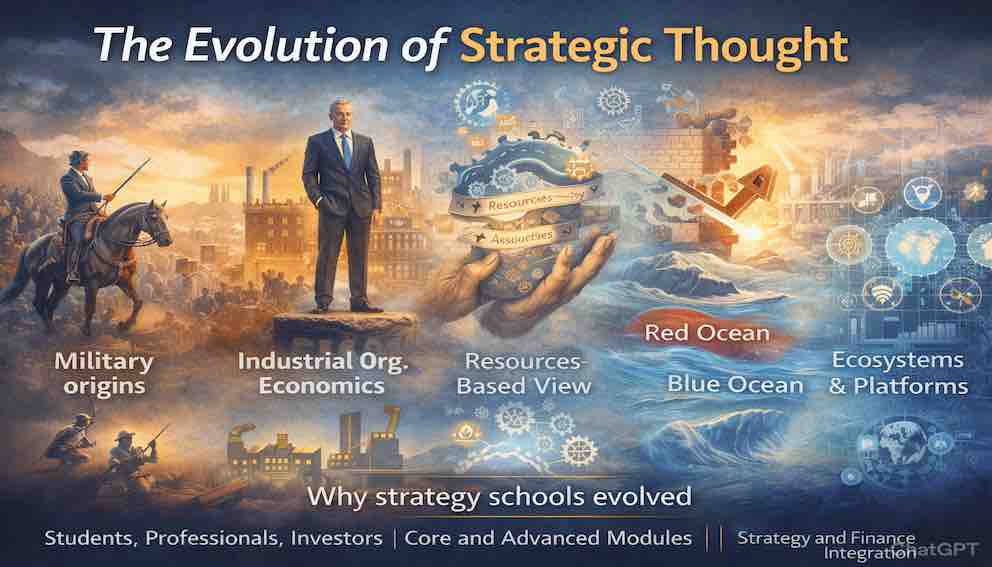
Strategy is not a static set of rules but a living tradition that has evolved over centuries in response to changing competitive landscapes, resources, and technologies. In this tutorial, we trace the journey of strategic thinking from Sun Tzu’s battlefield insights to industrial economics, Michael Porter’s frameworks, the Resource-Based View, dynamic capabilities, Blue Ocean Strategy, disruption theory, and modern ecosystem approaches. Each school of thought emerged to address limitations in previous frameworks, providing new ways to understand how organizations achieve and sustain advantage. By studying this evolution, you will gain both historical perspective and practical insight into how to apply these tools thoughtfully in today’s complex business environment.
Introduction: The Living Tradition of Strategy
Imagine a military commander in ancient China, surveying a battlefield at dawn. Your forces are outnumbered. The terrain favors the enemy. Supply lines are stretched thin. Yet you have one advantage: you know something your opponent does not.
Two thousand years later, imagine a CEO in Silicon Valley, observing a market at dawn. Competitors have more resources. The technology landscape shifts rapidly. Investors are impatient. Yet you see patterns your competitors overlook.
The word connecting these two scenarios is strategy. The context has changed, but the fundamental problem remains: how to create and sustain advantage under conditions of constraint, uncertainty, and incomplete information.
This tutorial traces how strategic thought evolved to solve this problem. Successive generations of thinkers discovered gaps in earlier approaches, and their insights accumulated into the rich body of knowledge we use today. By understanding this evolution, you not only see why strategic frameworks exist but also learn how to use them effectively.
The Origins: Strategy Before “Strategy”
Sun Tzu and The Art of War
More than two thousand years ago, during the Warring States period in ancient China (around 5th century BCE), the region was fragmented into multiple kingdoms constantly at war. Survival required cunning, foresight, and the ability to win battles without unnecessary loss. It was in this high-stakes environment that the Chinese general Sun Tzu wrote The Art of War, a text that transcended tactics to reflect on the nature of advantage itself.
Sun Tzu’s insights were revolutionary because he recognized that the best victories are often achieved without fighting, through clever planning, deception, and exploiting opportunity.
A quick story: Imagine a small kingdom threatened by a much larger neighbor. Instead of meeting them head-on, the king deploys Sun Tzu’s advice: he spreads misinformation about his troop strength, fortifies critical terrain, and attacks only the enemy’s weak supply lines. The larger army, overconfident and misinformed, falters without a major battle. The smaller kingdom survives—and thrives.
Key principles:
- Know yourself and your enemy: Effective choice depends on understanding both your capabilities and your competitor’s position.
- Terrain shapes possibility: Context dictates available moves and likely outcomes.
- Deception is a tool: Appear weak when strong, strong when weak, to create opportunities.
- Avoid strength, attack weakness: Exploit gaps instead of confronting a competitor’s core strengths.
These lessons were practical and grounded in experience, yet they remain relevant today because they address timeless realities: scarce information, asymmetric capabilities, and inevitable uncertainty.
Takeaway: Strategy is fundamentally about positioning, trade-offs, and careful anticipation, whether on an ancient battlefield or in a modern market.
The Greeks and Romans
In the West, military thought developed alongside the Chinese traditions but took a different form. Greek city-states like Athens and Sparta emphasized formation, discipline, and logistics. Imagine the Battle of Marathon: a smaller Greek force faced a numerically superior Persian army. The Greeks relied on tight phalanx formations and coordinated maneuvers, using discipline and preparation to overcome greater numbers. Speed, cohesion, and careful positioning allowed them to achieve victory despite their disadvantage.
Alexander the Great demonstrated another lesson: combining speed, surprise, and the integration of different military arms. At the Battle of Gaugamela, Alexander faced Darius III’s much larger Persian army. Instead of brute force, he used cavalry flanking maneuvers, coordinated infantry attacks, and psychological deception to create gaps in the enemy lines, winning decisively.
The Romans, meanwhile, added systemization to military success. Roman armies were not just collections of warriors—they were organized machines with standardized equipment, hierarchical command, and engineering support. Consider a Roman legion laying siege to a fortified city: engineers constructed ramps, bridges, and siege engines, while disciplined units executed coordinated attacks. This structure allowed Rome to consistently produce competent commanders and sustain empire-wide campaigns over centuries.
Takeaway: Strategy involves deliberate organization, planning, and coordination—lessons directly applicable to modern business.
The Military Legacy for Business
These ancient military stories offer more than historical interest—they illuminate modern business strategy:
- Competition for scarce resources: Like armies vying for territory, businesses compete for market share, talent, and capital.
- Deliberate positioning relative to competitors: Greek phalanxes, Alexander’s flanks, and Roman formations show the power of positioning and focus.
- Operations under uncertainty and incomplete information: Unpredictable terrain, enemy movements, and supply constraints mirror market unpredictability.
- Rewards for anticipation, planning, and trade-offs: Success comes from understanding constraints and making deliberate choices, not reacting randomly.
Link to the meaning of strategy: Whether on a battlefield or in a marketplace, strategy is about making deliberate choices to create and sustain advantage. The lessons of the Greeks and Romans remind us that thoughtful planning, disciplined execution, and organizational design are just as critical today as they were two millennia ago.
The Industrial Revolution: When Scale Changed the Nature of Strategy
The Industrial Revolution did more than transform production—it reshaped the very concept of strategy. Before, strategic thinking focused on battlefield-like decisions: positioning, anticipating the enemy, and exploiting weaknesses. Now, businesses faced new dimensions of scale, complexity, and coordination. Firms could grow nationally and internationally, but with growth came challenges that no individual or small team could manage alone. Strategy was no longer just clever moves—it became the design of organizations, systems, and processes to operate effectively in an uncertain and expanding environment.
The Rise of the Large Corporation: Vanderbilt’s Strategic Innovation
Consider Cornelius Vanderbilt, mid-19th century entrepreneur and railroad magnate. Railroads were the arteries of commerce, but building a national network involved enormous complexity: thousands of miles of track, bridges, depots, employees, and schedules. Mistakes were costly, and competitors were eager to imitate success.
Most leaders focused on rapid expansion, but Vanderbilt understood that the organization itself could be a source of competitive advantage.
- Coordinating divisions: Vanderbilt created standardized reporting systems and operational procedures, ensuring each regional office followed consistent rules, shared insights, and avoided costly duplication.
- Capital allocation with foresight: He invested strategically in high-return lines, balancing risk and opportunity across his sprawling network.
- Operational consistency: Safety protocols, maintenance standards, and strict scheduling made his operations reliable, efficient, and difficult to replicate.
Vanderbilt’s brilliance was that he treated management, structure, and coordination as strategic levers—turning complexity into a competitive advantage that went far beyond simply laying track.
From Operational Genius to Strategic Insight
Vanderbilt’s story illustrates a broader shift in strategic thinking during the Industrial Revolution:
- Scale introduced systemic challenges: Managing thousands of employees, miles of infrastructure, and dispersed operations required deliberate organization.
- Strategy moved beyond individual action: Success depended on designing systems, processes, and hierarchies that could function reliably across large organizations.
- Managerial choice became central: While industry conditions mattered, firms that combined environmental insight with disciplined execution—like Vanderbilt’s—could outperform rivals even in the same sector.
This period marked the emergence of strategic management as a formal concern. Strategy was no longer about one clever decision at the right time; it now included how to structure, coordinate, and govern an organization at scale.
Industrial Organization Economics: Mapping the Environment
Economists began studying these growing corporations systematically, giving rise to Industrial Organization (IO) economics, which emphasized that industry structure shapes opportunity:
- Concentrated industries (railroads, steel, chemicals) with high entry barriers offered higher profit potential.
- Fragmented industries (small retailers, artisans) offered little sustained advantage.
The lesson: where you compete matters as much as how you compete. Firms that understood industry dynamics could make informed strategic choices. Vanderbilt’s success showed that insight plus disciplined execution—understanding the landscape and designing systems to operate within it—was a decisive advantage.
Key Takeaway
The Industrial Revolution transformed strategy from battlefield-style thinking to strategic management for complex organizations.
- Scale and complexity demanded organizational design, coordination, and prioritization.
- Understanding the industry context became critical, but managerial choice and execution remained decisive.
- Firms that mastered both—environmental insight and operational brilliance—gained enduring advantage, while others fell behind.
In short, this era shows that strategy evolves with the challenges faced by organizations. From Sun Tzu’s battlefield to Vanderbilt’s railroads, the core principle remains: strategy is about making deliberate choices under constraint—but the nature of those choices changes as the world changes.
Michael Porter: Strategy Becomes a Discipline
By the late 20th century, managers faced a new challenge: industries were crowded, competition was intense, and firms could no longer rely on intuition or trial-and-error to survive. Enter Michael Porter, a Harvard scholar who transformed strategy from a set of loosely connected ideas into a formal management discipline.
In his landmark book, Competitive Strategy (1980), Porter provided tools to analyze industries systematically and make deliberate choices, giving managers a way to see not just what was happening, but why.
The Five Forces: Diagnosing Competition
Imagine you are an executive at a budding airline in the 1980s. Profits are thin, competition is fierce, and every operational decision feels like a gamble. Porter’s Five Forces framework offers a lens to understand why:
- Rivalry among existing competitors: Airlines compete fiercely on price, routes, and service.
- Threat of new entrants: Building an airline is capital-intensive, but leasing aircraft and discount models make entry possible.
- Supplier bargaining power: Boeing, Airbus, and labor unions hold significant leverage over costs.
- Buyer bargaining power: Customers can now compare fares online, making switching easy.
- Threat of substitutes: Trains, cars, or video conferencing offer alternative ways to travel.
Using this framework, you realize that profitability is shaped as much by industry structure as by your own decisions. Strategy is no longer about isolated choices—it’s about understanding the forces that define the playing field.
Takeaway: Strategy requires a systematic approach to diagnosing competition, not just reactive decision-making.
Generic Strategies: The Importance of Choice
Porter’s next insight was equally profound: sustainable advantage depends on deliberate choices and trade-offs. Firms cannot be everything to everyone. Porter defined three generic strategies:
- Cost leadership: Be the lowest-cost producer.
- Differentiation: Offer unique value that commands a premium price.
- Focus: Serve a narrow segment more effectively than broader competitors.
Southwest Airlines: A Story of Strategic Choice
Consider Southwest Airlines, a company that applied Porter’s principles brilliantly:
- Single aircraft type: Simplified maintenance, training, and scheduling.
- Point-to-point routes: Reduced delays and turnaround times.
- No frills: Eliminated meals and first class to cut costs.
- Quick turnarounds: Maximized aircraft utilization and revenue.
Each decision reinforced the others, creating a systemic advantage. Competitors could copy individual elements, but only Southwest had built an integrated system that delivered consistent cost leadership.
Limitations and Lessons
Porter’s frameworks were powerful but static. They emphasized industry structure and positioning, but said less about building unique capabilities over time or adapting to environmental shifts. Later frameworks, like the Resource-Based View and Dynamic Capabilities, would address these gaps.
Takeaway: Strategy is about making clear choices and sticking to them. You can’t try to be everything at once—if you try to cut costs and offer luxury at the same time, you risk being “stuck in the middle,” pleasing no one. Instead, each decision should support the others, like pieces of a puzzle fitting together. When your choices align across operations, products, and services—just like Southwest Airlines using a single aircraft type, point-to-point routes, and quick turnarounds—they create a systemic advantage that competitors find hard to copy.
The Resource-Based View: Looking Inward
Even within the same industry, some companies consistently outperform others, and traditional models like Porter’s Five Forces couldn’t fully explain why. This puzzle gave rise to the Resource-Based View (RBV): the idea that a firm’s sustained advantage comes not just from the industry it competes in, but from the unique bundle of resources and capabilities it possesses.
Core Insight: Strategy is about identifying, protecting, and leveraging what your firm does differently and better than anyone else. Not all resources are equally valuable—some provide real advantage, others do not.
The VRIO Framework helps evaluate resources:
- Valuable: Does it help exploit opportunities or defend against threats?
- Rare: Is it unique or scarce among competitors?
- Inimitable: Can competitors copy it easily?
- Organized: Is the firm structured to fully capture value from it?
Apple Example:
- Design capability: Seamless integration of hardware, software, and services creates products that feel effortless to use.
- Brand equity: Long-term customer loyalty allows premium pricing.
- Ecosystem lock-in: iPhones, Macs, and iCloud work together, making switching costly.
- Supply chain expertise: Global sourcing and logistics ensure efficiency and reliability.
Apple’s advantage isn’t just one resource—it’s how these capabilities reinforce each other, making it extremely difficult for competitors to replicate.
Limitation: RBV is largely static. Resources that once provided an edge can become obsolete if the environment changes. Consider Kodak: strong brand, technology, and distribution capabilities were insufficient to survive the digital photography revolution.
Takeaway: Strategy is not only about choosing markets but about leveraging unique, hard-to-copy resources to create a competitive edge.
Dynamic Capabilities: Strategy in Motion
RBV explains what resources give advantage, but it doesn’t explain how to stay ahead when the world changes. That’s where dynamic capabilities come in: the ability of a firm to adapt, innovate, and reconfigure resources to meet new challenges.
Dynamic Capabilities Require:
- Sensing: Identifying opportunities and threats early.
- Seizing: Investing in the right resources or initiatives.
- Transforming: Reconfiguring assets, processes, and structures to stay competitive.
Netflix Example:
- Started as a DVD rental service with strong logistics and recommendation systems.
- Sensed the rise of streaming and the decline of physical rentals.
- Seized the opportunity by investing in streaming infrastructure and original content.
- Transformed its organization, culture, and processes to dominate the streaming market.
Takeaway: Strategy is not static. Competitive advantage depends on continuously adapting resources and capabilities to evolving environments. Firms that master dynamic capabilities turn RBV into a living, evolving advantage rather than a snapshot in time.
Blue Ocean Strategy: Creating New Markets
Imagine you run a traditional circus in the 1980s. Every city has a circus, everyone competes for the same families, and profits are squeezed. Competing in this “red ocean” feels exhausting: you fight over the same audience, offer slightly better acts, slightly lower prices, and end up in endless rivalry.
Blue Ocean Strategy teaches a different approach: instead of battling in crowded markets, create new demand by offering something genuinely different—achieving differentiation and low cost simultaneously.
Cirque du Soleil Example:
- Removed animals and star performers (cost reduction, simplified operations).
- Focused on artistic storytelling, choreography, and original music (unique value creation).
- Targeted adult audiences willing to pay a premium, a segment traditional circuses ignored.
By redefining the market, Cirque du Soleil didn’t just compete—it created a new category. Competitors were irrelevant because the rules of the game had changed.
Takeaway: Strategy can make competition irrelevant, but creating a blue ocean is not a one-time move. Constant innovation and renewal are required to stay ahead.
Disruption Theory: When Giants Fall
Now, picture being the CEO of a dominant mainframe computer company in the 1970s. Your products are sophisticated, profitable, and trusted by enterprises worldwide. Then a new class of personal computers emerges: cheaper, simpler, initially appealing only to hobbyists.
Clayton Christensen’s Disruption Theory explains why firms like yours—well-managed and focused on sustaining innovation—can fail when disruptive innovations emerge.
- Sustaining innovation: Improve existing products for current customers.
- Disruptive innovation: Introduce simpler, cheaper solutions initially serving overlooked segments, which eventually threaten incumbents.
Personal Computer Revolution Example:
- Early PCs were ignored by mainframe companies.
- Over time, PCs improved, became mainstream, and replaced many mainframe functions.
- Companies that didn’t sense and adapt to the emerging threat lost dominance, despite being well-managed.
Takeaway: Strategy is not just about current advantage. Firms must monitor emerging threats, anticipate market shifts, and adapt early to avoid being overtaken by seemingly minor innovations.
Ecosystem Strategy: Beyond the Firm
Imagine building a business where your success depends not just on what you do, but on how everyone connected to you behaves. This is the essence of ecosystem strategy: orchestrating networks of participants whose interactions create self-reinforcing value.
Apple Example:
- More iPhone users attract more app developers to the App Store.
- More developers create better apps, which attract even more users.
- Accessories, services, and content ecosystems grow in parallel, locking in customers and creating network effects.
- Apple’s internal resources—design, software, and supply chain—work in harmony with this ecosystem to magnify advantage.
Airbnb Example:
- More hosts attract more guests.
- More guests attract more hosts and encourage reviews, ratings, and trust signals.
- Service partners (cleaning, experiences) improve the platform’s offering, increasing the value for all participants.
- The platform itself becomes more valuable as a network, not just because of internal processes.
Takeaway: Modern strategy is increasingly about designing and orchestrating ecosystems, not just optimizing internal operations. Leaders must understand how participants interact, how value is amplified across networks, and how to keep the ecosystem healthy. A firm that manages its ecosystem well can create advantages that are difficult—or impossible—for competitors to replicate.
Why This Evolution Matters
Each school of thought in strategic management emerged to address limitations of its predecessors:
- Military strategy: taught positioning, trade-offs, and anticipation.
- Industrial economics: highlighted the role of industry structure.
- Porter: formalized deliberate choice and reinforcing actions.
- RBV: focused on firm-specific capabilities.
- Dynamic capabilities: emphasized continuous adaptation.
- Blue Ocean: encouraged creating entirely new markets.
- Disruption: revealed the risks of peripheral entrants.
- Ecosystem: demonstrated the power of networks and platforms.
Modern challenges—digital transformation, environmental-social-governmental imperatives, and geopolitical risk—show that strategy is still evolving. Yet the core principle remains: strategy is about deliberate choice under uncertainty, designed to create and sustain competitive advantage. Understanding the evolution of strategic thought equips students and professionals to see both the how and why of every decision, from positioning to innovation to ecosystem orchestration.
Conclusion: The Continuing Evolution of Strategic Thought
Strategy is a living tradition, shaped by centuries of accumulated insight. Understanding its evolution helps you see that frameworks are tools, not ends in themselves.
- Strategy is deliberate choice under uncertainty
- Advantage depends on positioning, unique resources, adaptation, innovation, and networks
- Effective strategists combine frameworks, knowing which lens applies when
However, tools alone do not give direction. They explain how to compete, but not why—what the organization stands for and where it aspires to go. That clarity comes from mission, vision, and strategic intent, which is the focus of the next tutorial.
Key Takeaways
- Military strategy introduced positioning, trade-offs, and anticipating competitors.
- Industrial economics emphasized industry structure but underestimated firm-specific differences.
- Porter formalized trade-offs and positioning; being “stuck in the middle” is perilous.
- RBV shifted focus inward: unique, inimitable resources are the foundation of advantage.
- Dynamic capabilities added adaptation over time: sensing, seizing, transforming.
- Blue Ocean Strategy: create new markets to make competition irrelevant.
- Disruption theory: successful incumbents can fail when faced with disruptive innovation.
- Ecosystem strategy: value derives from networks, platforms, and interactions.
- No single framework is complete; strategic fluency requires integration.
- Strategy continues evolving in response to digital transformation, ESG imperatives, and geopolitical shifts.
Next Step: We will explore how mission, vision, and strategic intent provide the purpose and direction that make strategy coherent and actionable.
About Swati Sharma
Lead Editor at MyEyze, Economist & Finance Research WriterSwati Sharma is an economist with a Bachelor’s degree in Economics (Honours), CIPD Level 5 certification, and an MBA, and over 18 years of experience across management consulting, investment, and technology organizations. She specializes in research-driven financial education, focusing on economics, markets, and investor behavior, with a passion for making complex financial concepts clear, accurate, and accessible to a broad audience.
Disclaimer
This article is for educational purposes only and should not be interpreted as financial advice. Readers should consult a qualified financial professional before making investment decisions. Assistance from AI-powered generative tools was taken to format and improve language flow. While we strive for accuracy, this content may contain errors or omissions and should be independently verified.